Register For Our Mailing List

Register to receive our free weekly newsletter including editorials.

Home / 545

CPI lowballs the true cost of living

Why is Prime Minister Anthony Albanese suddenly so keen to deliver extra cost-of-living relief? One immediate reason is he is keen to make sure Labor wins the upcoming byelection in the outer-Melbourne electorate of Dunkley on March 2. But the cost of living wouldn’t matter much for Dunkley – and it wouldn’t matter much for the rest of us – unless it was really biting.

And despite what the Treasurer himself has been trying to tell us, it is biting.

Treasurer Jim Chalmers has been pointing out that in the June quarter and the September quarter (the three months to June and to September) real wages grew for the first time in years. By that he means that the wages index compiled by the Bureau of Statistics began growing faster than the consumer price index.
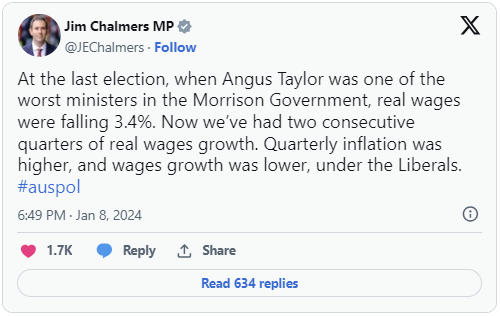
It’s better than growing more slowly, but it tells us next to nothing about what’s happening to buying power. Here’s why.

Why CPI understates today’s living costs

Way back in the late 1990s, more than a quarter of a century ago, the consumer price index (CPI) used to actually reflect the cost of living. It included all of the big costs incurred by households, including – importantly – mortgage interest payments. At the time, mortgages accounted for an average of $5 of every $100 each wage earner spent.

Then in September 1998, in response to representations from the Reserve Bank and the Treasury, the bureau changed the way it calculated the index. It excluded mortgage and other interest payments, in a decision it acknowledged would make the index worse at measuring living costs.

It still carries the warning on its website, saying the consumer price index is

not the conceptually ideal measure for assessing the changes in the purchasing power of the disposable incomes of households.

The index actually does a pretty good job of measuring changes in living costs at times when mortgage rates aren’t much changing. But at times when they are tumbling, it’ll overestimate living costs. And when mortgage rates are soaring – as they have been lately – it will way understate what’s happening to living costs.

We know by how much. For years, the bureau has also published a separate set of measures it pointedly calls “living cost indexes”. These do include mortgage and other interest charges, and for households headed by employees (for whom the buying power of wages matters), they are substantial.

Living costs are up 9%

While the consumer price index (the one quoted by the treasurer) increased 4.1% for the year to December, the latest living cost index for households headed by wage earners climbed 9%.

For these working households, the price of food climbed 4.8% in the year to September, the price of electricity 14.5% and the price of mortgage interest charges 68%.

It’s the increases in mortgage rates that have made the increases in the other prices hurt so much.

The overall increase in prices faced by wage-earners – 9% – is way above the typical wage increase of 4%.

Bill Mitchell of the University of Newcastle points out that on this measure, the correct one, the buying power of wages has been falling for two and a half years. He says it puts the treasurer’s comments in a wholly different light.

Why we should distrust the CPI

Working Australians are right to distrust the consumer price index, which is something the Australian Council of Social Service warned the bureau about when it made the change.

Each month, the Melbourne Institute asks Australians whether their family finances have deteriorated over the previous year. Usually, about one-third of those surveyed say they have.

But for more than a year now, around 50% of those surveyed have been saying their finances have got worse. That’s a peak not seen since the global financial crisis, and one that has lasted longer.


Asked about family finances over the next 12 months, more than 30% say they’ll worsen further. It’s usually 20%.


Looked at from today’s perspective, the arguments put forward in 1997 for weakening the consumer price index as a measure of living costs are unimpressive.

Back then, the Treasury noted that many welfare recipients didn’t have mortgages and that a consumer price index that excluded them would better reflect their living costs.

The Reserve Bank argued interest rates were “conceptually different from other prices”. In any event, it wanted them excluded because it found it hard to use higher interest rates to bring down inflation if those higher rates pushed the measure of inflation up.

The change attracted little attention at the time, because mortgage rates weren’t moving much. By the time they did, the change had been bedded down.

But here’s some good news

For most of the time since the change, mortgage rates have either increased gradually or been cut, meaning the difference between what the consumer price index has been telling us and what’s been happening to us hasn’t been too stark. It’s been stark lately because interest rates have been rising quickly.

The good news – and there is good news – is that financial markets expect rates to begin falling this year, with the next move down.

Inflation as measured by the consumer price index (inflation excluding mortgage rates) is already falling.


It makes now a particularly good time to announce measures to address the cost-of-living crisis. We need them because we really are in something of a crisis. Things are a lot worse than the official index suggests.

And there’s a chance that soon they’ll begin to get better, allowing the prime minister to claim a win.The Conversation

Peter Martin, Visiting Fellow, Crawford School of Public Policy, Australian National University

This article is republished from The Conversation under a Creative Commons license. Read the original article.


  •   31 January 2024
  • 5
  •      
  •   
5 Comments
Economist
February 01, 2024

Yes but it does measure the rate of inflation of goods and services prices. And does it quite well.
Mortgage interest is not paying for goods or services. It's the (main) recurrent cost of acquiring an asset. That's a very different thing. Which is why the ABS is correct - like other statistics agencies around the world - to have dropped interest costs from the CPI.

So please don't criticise the CPI for failing to serve a different agenda. If interest rates are too high then that's a valid concern to have. But you can observe that fact quite well without implying that the CPI is failing us for not including it.

John Abernethy
February 04, 2024

I think that the Economist and Peter actually agree. The CPI is not a good measure of the actual increase cost of living or indeed the cost of doing business. That is the fallacy promoted by politicians who use it to justify either adjusting tax rates or doing nothing.

I suspect the better inclusion for both the CPI and the cost of living is the movement in actual rent increases. That is a cost that is related to interest rates, inflation and demand/supply.

Rental costs are included in the CPI measurement and so the question is the appropriate weighting. Of course, for home owners the movement in rentals does not affect their cost of living - unless they are subsidising their children with their rent.

It’s a complicated subject to argue with so many moving parts and I appreciate both Peter’s intention and the Economists view.

Dudley
February 02, 2024

"For most of the time since the change, mortgage rates have either increased gradually or been cut, meaning the difference between what the consumer price index has been telling us and what’s been happening to us hasn’t been too stark.":

Mortgage rates are about the same as inflation after discounting tax.
"Free money", or at least low cost, where the mortgaged asset price increases with inflation.

More importantly, real after tax deposit rates are negative due to taxing both real and imaginary (inflationary) gains:
30% tax, 5% yield, 4.5% inflation
= (1 + (1 - 30%) * 5%) / (1 + 4.5%) - 1
= -0.957%

Russell Hancock
February 04, 2024

In 1998 the Reserve effectively gave away its responsibility for control of house prices but retained responsibility for
most other prices via its broad inflation mandate . So since then whoever or whatever is responsible for house prices , basic shelter items for all families , is asleep at the wheel . So the real question becomes , should responsibility for house prices be given back to the Reserve Bank ?

Economist
February 04, 2024

Russell the RBA never had a mandate to control house prices so they couldn't have "given it away". Their mandate has always been inflation and employment.
Not sure what you think happened in 1998. The first explicit inflation targeting document was signed in 1996 when the Howard-Costello government came in, after the RBA adopting 2-3% on average as its working target under Bernie Fraser in 1993.


Leave a Comment:

RELATED ARTICLES

A capital gains tax discount is legitimate but how much?

Energy policy must prioritise the economy

Taking from the young, giving to the old

banner

Most viewed in recent weeks

Building a lazy ETF portfolio in 2026

What are the best ways to build a simple portfolio from scratch? I’ve addressed this issue before but think it’s worth revisiting given markets and the world have since changed, throwing up new challenges and things to consider.

Get set for a bumpy 2026

At this time last year, I forecast that 2025 would likely be a positive year given strong economic prospects and disinflation. The outlook for this year is less clear cut and here is what investors should do.

Meg on SMSFs: First glimpse of revised Division 296 tax

Treasury has released draft legislation for a new version of the controversial $3 million super tax. It's a significant improvement on the original proposal but there are some stings in the tail.

Ray Dalio on 2025’s real story, Trump, and what’s next

The renowned investor says 2025’s real story wasn’t AI or US stocks but the shift away from American assets and a collapse in the value of money. And he outlines how to best position portfolios for what’s ahead.

10 fearless forecasts for 2026

The predictions include dividends will outstrip growth as a source of Australian equity returns, US market performance will be underwhelming, while US government bonds will beat gold.

13 million spare bedrooms: Rethinking Australia’s housing shortfall

We don’t have a housing shortage; we have housing misallocation. This explores why so many bedrooms go unused, what’s been tried before, and five things to unlock housing capacity – no new building required.

Latest Updates

3 ways to fix Australia’s affordability crisis

Our cost-of-living pressures go beyond the RBA: surging house prices, excessive migration, and expanding government programs, including the NDIS, are fuelling inflation, demanding bold, structural solutions.

Superannuation

The Division 296 tax is still a quasi-wealth tax

The latest draft legislation may be an improvement but it still has the whiff of a wealth tax about it. The question remains whether a golden opportunity for simpler and fairer super tax reform has been missed.

Superannuation

Is it really ‘your’ super fund?

Your super isn’t a bank account you own; it’s a trust you merely benefit from. So why would the Division 296 tax you personally on assets, income and gains you legally don’t own?

Shares

Inflation is the biggest destroyer of wealth

Inflation consistently undermines wealth, even in low-inflation environments. Whether or not it returns to target, investors must protect portfolios from its compounding impact on future living standards.

Shares

Picking the next sector winner

Global equity markets have experienced stellar returns in 2024 and 2025 led, in large part, by the boom in AI. Which sector could be the next star in global markets? This names three future winners.

Infrastructure

What investors should expect when investing in infrastructure: yield

The case for listed infrastructure is built on stable earnings and cash flows, which have sustained 4% dividend yields across cycles and supported consistent, inflation-linked long-term returns.

Investment strategies

Valuing AI: Extreme bubble, new golden era, or both

The US stock market sits in prolonged bubble territory, driven by AI enthusiasm. History suggests eventual mean reversion, reminding investors to weigh potential risks against current market optimism.

Sponsors

Alliances

© 2026 Morningstar, Inc. All rights reserved.

Disclaimer
The data, research and opinions provided here are for information purposes; are not an offer to buy or sell a security; and are not warranted to be correct, complete or accurate. Morningstar, its affiliates, and third-party content providers are not responsible for any investment decisions, damages or losses resulting from, or related to, the data and analyses or their use. To the extent any content is general advice, it has been prepared for clients of Morningstar Australasia Pty Ltd (ABN: 95 090 665 544, AFSL: 240892), without reference to your financial objectives, situation or needs. For more information refer to our Financial Services Guide. You should consider the advice in light of these matters and if applicable, the relevant Product Disclosure Statement before making any decision to invest. Past performance does not necessarily indicate a financial product’s future performance. To obtain advice tailored to your situation, contact a professional financial adviser. Articles are current as at date of publication.
This website contains information and opinions provided by third parties. Inclusion of this information does not necessarily represent Morningstar’s positions, strategies or opinions and should not be considered an endorsement by Morningstar.