Register For Our Mailing List

Register to receive our free weekly newsletter including editorials.

Home / 347

Are Australian bank boards fit for purpose?

Australian banks have certainly taken criticism over the last couple of years, much of it deserved and some of it produced for the pleasure of the media. Banks have been in a never-ending cycle of public-attested mistakes. While culture and greed are often cited, I doubt this is really the case.

One area worth exploring is whether banks have the right management and governance experience for the modern business environment. This is not a question of a director’s ‘smarts’ but rather if traditional experiences are still as relevant.

Most recent bank losses have little to do with lending losses. They have been operational failures.

CBA copped a $700 million dollar fine for its “software error” causing breaches with AUSTRAC’s anti-money laundering (AML) rules.

Westpac lost its CEO and Chairman due to AML failures on small international transactions in what AUSTRAC said was due to a lack of "appropriate IT systems and automated solutions”.

In many respects, a cold analysis of banking governance suggests the above examples were accidents waiting to occur.

First, the good news. When running a heatmap over the skills of bank directors, they rate well in the core skills of ‘Risk and Audit’, ‘Economic and Financial Theory’, ‘Accounting’, ‘Industry Expertise’ and holding responsibilities in ‘Large Commercial Business’.
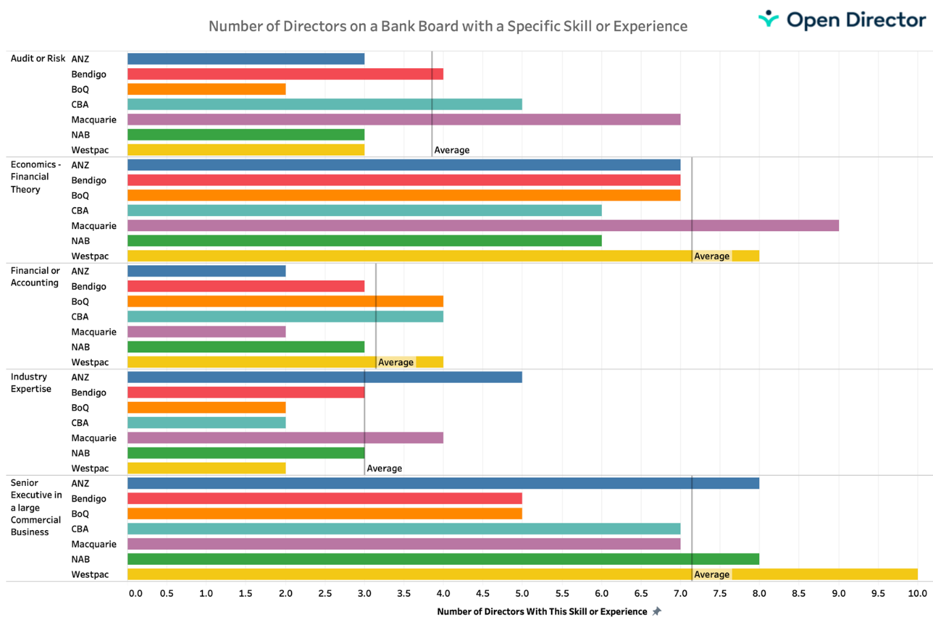
But times are changing at an ever-increasing pace. The required skills from a director ten years ago are not those required today. Banks now resemble huge digital machines run at high speed sitting on top of large capital bases. Staff numbers are continually cut and those remaining have more diverse and larger responsibilities.

Unfortunately, many bank directors lack some really important business experience. They don’t understand technology, they don’t have operations skills and they are light on human resource experience. These skills are thought to exist because they may have held senior roles like a CEO of a large company.

The reality is you need hands-on experience and scar tissue from being deeply involved in technology and operations to know where the subtle but real risks exist.

Technology is moving under our feet as it evolves and living with these new risks and ambiguity can only be learnt on the front line. Being a ‘good people manager’ will only give a partial credit for these complex skills.

When we look at these new skill requirements our directors are coming up short.
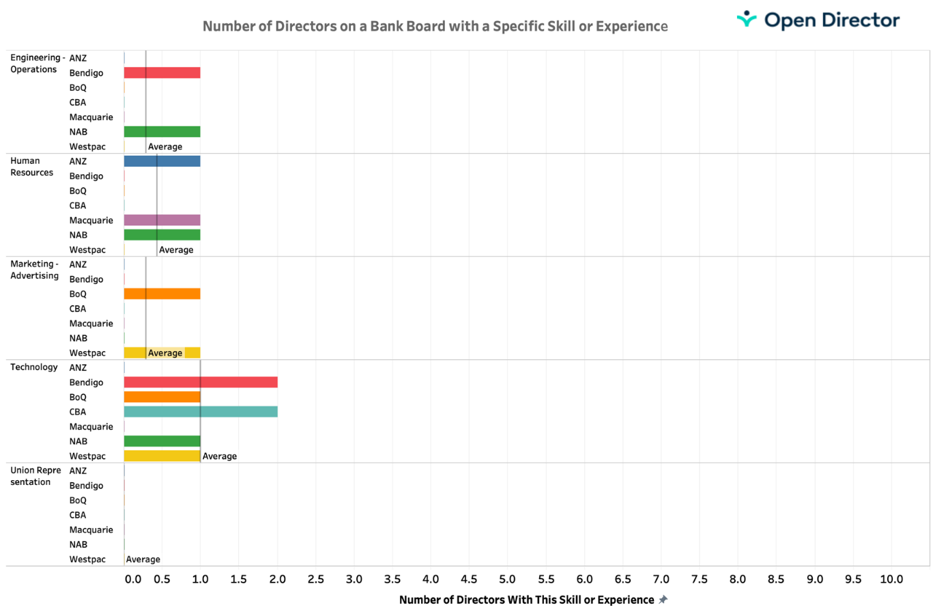
This second table clearly shows that banks could materially improve the diversity of skills on a board. Historically, many would argue that these skills are of second order. Directors need to know how to run big companies with large staff numbers.

But that is no longer the case. Knowing how to run technology is perhaps even more important in avoiding a scandal that makes the front page of the Australian Financial Review than in driving commercial success.


Donald Hellyer is Director of OpenDirector and CEO of the development company BigFuture.


  •   4 March 2020
  • 4
  •      
  •   
4 Comments
Jonathan
March 04, 2020

Thanks Donald - another overlooked skill for bank boards is credit assessment. Insolvent banks are almost always brought down by bad lending, but few (usually none) of the directors understand how to lend money. It's like a retailer (Coles, Woolworths or Myer) having no one with retail experience on their board - it would seem an obvious oversight. Banks are very large beasts requiring a wide range of skills to be managed correctly.

Donald Hellyer
March 04, 2020

Agreed Jonathan, it just that recent losses in the banking sector have been tech related. I am sure lending losses will return again!!

Steve
March 07, 2020

Of greater concern is that the banks have become the political punching bags of the Industry Super funds. Given their recent run of mergers, they are slowly evolving into 4 pillars themselves & with close to 1 trillion in FUM & fast growing, are becoming far too powerful. Perhaps the Fed Govt should introduce anti-trust legislation to prevent them controlling Bank Boards, or any other publicly listed company.

Sandi
March 07, 2020

Taking the skills matrix to the next level - very useful tool.
It also adds to discussion of role of the Board and the Executive in the business management...
If Technology or HR are specific skills that are not represented on the Bank Board and they should be - not sure how a HR professional or CTO/CIO will actually get invited to join these Boards against current criteria.


Leave a Comment:

RELATED ARTICLES

Why 'boring' Big Four banks remain attractive

Who gets the gold stars this bank reporting season?

The value of wealth management for Australian banks

banner

Most viewed in recent weeks

Australian stocks will crush housing over the next decade, 2025 edition

Two years ago, I wrote an article suggesting that the odds favoured ASX shares easily outperforming residential property over the next decade. Here’s an update on where things stand today.

Australia's retirement system works brilliantly for some - but not all

The superannuation system has succeeded brilliantly at what it was designed to do: accumulate wealth during working lives. The next challenge is meeting members’ diverse needs in retirement. 

Get set for a bumpy 2026

At this time last year, I forecast that 2025 would likely be a positive year given strong economic prospects and disinflation. The outlook for this year is less clear cut and here is what investors should do.

Meg on SMSFs: First glimpse of revised Division 296 tax

Treasury has released draft legislation for a new version of the controversial $3 million super tax. It's a significant improvement on the original proposal but there are some stings in the tail.

Building a lazy ETF portfolio in 2026

What are the best ways to build a simple portfolio from scratch? I’ve addressed this issue before but think it’s worth revisiting given markets and the world have since changed, throwing up new challenges and things to consider.

The 3 biggest residential property myths

I am a professional real estate investor who hears a lot of opinions rather than facts from so-called experts on the topic of property. Here are the largest myths when it comes to Australia’s biggest asset class.

Latest Updates

Investment strategies

Building a lazy ETF portfolio in 2026

What are the best ways to build a simple portfolio from scratch? I’ve addressed this issue before but think it’s worth revisiting given markets and the world have since changed, throwing up new challenges and things to consider.

Investment strategies

21 reasons we’re nearing the end of a secular bull market

Nearly all the indicators an investor would look for suggest that this secular bull market is approaching its end. My models forecast that the US is set for 0% annual returns over the next decade.

Property

13 million spare bedrooms: Rethinking Australia’s housing shortfall

We don’t have a housing shortage; we have housing misallocation. This explores why so many bedrooms go unused, what’s been tried before, and five things to unlock housing capacity – no new building required.

Investment strategies

Market entry – dip your toe or jump in all at once?

Lump sum investing usually wins, but it can hurt if markets fall. Using 50 years of Australian data, we reveal when staging your entry protects you, and when it drags on returns. 

Investment strategies

The US$21 trillion question: is AI an opportunity or excess?

It has been years since the US stock market has been so focused on a single driving theme, and AI is unquestionably that theme. This explores what it means for US and global markets in 2026.

Economy

US energy strategy holds lessons for Australia

The US has elevated energy to a national security priority, tying cheap, reliable power to economic strength, AI leadership, and sovereignty. This analyses the new framework and its implications for Australia.

Strategy

Venezuela’s democratic roots are deeper than Trump knows

Most people know Maduro was a dictator and Venezuela has oil. Few grasp the depth of suffering or the country’s democratic history - essential context as the US ousts Maduro and charts Venezuela’s future. 

Sponsors

Alliances

© 2026 Morningstar, Inc. All rights reserved.

Disclaimer
The data, research and opinions provided here are for information purposes; are not an offer to buy or sell a security; and are not warranted to be correct, complete or accurate. Morningstar, its affiliates, and third-party content providers are not responsible for any investment decisions, damages or losses resulting from, or related to, the data and analyses or their use. To the extent any content is general advice, it has been prepared for clients of Morningstar Australasia Pty Ltd (ABN: 95 090 665 544, AFSL: 240892), without reference to your financial objectives, situation or needs. For more information refer to our Financial Services Guide. You should consider the advice in light of these matters and if applicable, the relevant Product Disclosure Statement before making any decision to invest. Past performance does not necessarily indicate a financial product’s future performance. To obtain advice tailored to your situation, contact a professional financial adviser. Articles are current as at date of publication.
This website contains information and opinions provided by third parties. Inclusion of this information does not necessarily represent Morningstar’s positions, strategies or opinions and should not be considered an endorsement by Morningstar.