Register For Our Mailing List

Register to receive our free weekly newsletter including editorials.

Home / 552

Finding single-digit PE stocks in an overvalued market

The most interesting high-level observation on markets at the moment is the fact that they are selling at an all-time high despite the elevation of geopolitical tension, complete confusion on the forward path of the economy, and the increasing technical skew in market indices that is no doubt a function of the never-ending march of passive investing.

Geopolitically, we have the real threat of war in Taiwan, the ongoing war in the Middle East, and the tragic war in the Ukraine.

On the economy, PM Capital’s view has not changed. We always thought that the economy would sustain itself through 2024 and that there was now a higher floor in inflation, meaning that although rates have gone up enough to dampen an already slowing economy, with higher embedded inflation and an economy that was in reasonable shape, it was unlikely that rates would need to fall too much or too soon. Central bankers could afford to be patient and historically, 4% interest rates are not that high especially given higher embedded inflation.

I would also reiterate the danger of making decisions based on macro-economic forecasts. In the last 12 months, market sentiment was convinced of the imminent recession, then became convinced of a soft landing, then started talking about no landing and now economic indicators are suggesting an upturn. Who knows?

The other feature of today’s markets is the unhealthy concentration of daily trading and the impact on market performance of what was the top ten stocks in the United States, then becoming the Magnificent Seven and the way it is going, likely to end up in the one and only – Nvidia.

It is interesting to note how the industry is always rabbiting on about concentration of risk yet here we are today with the greatest concentration of risk in the fewest stocks that we have ever seen. That creates the perfect opportunity for investors to diversify from that risk and take advantage of where the valuation opportunities are.

1 CBA = 3 of Europe’s top banks

That brings me to my favourite topic – Valuation.

Back in October we highlighted that “when I look at our portfolio, valuations still appear to be in our favour. …the overall Price-Earnings ratio of the portfolio is in absolute terms, probably as low a number as I can recall”. So, the uplift in the market from the September lows has not really surprised me.

What does surprise me is that valuations in some of our investment themes are more like what you see at the bottom of a market, not the top. Single digit PE ratios and double-digit dividend yields.

The most extreme example is our European Banks, selling on a 6x PE and a 10% dividend yield*. Here is an interesting anecdote.

CBA, the largest bank in Australia, has a market value of circa $200 billion and receives $1 of every $10 that flows into the Australian Stock Exchange from passive funds^. For $200 billion, you can buy some of the largest retail banks in Europe, like Lloyds in the UK, Caixia Bank in Spain, plus Intesa in Italy. The population of Australia is nearly 26 million. The combined population of the UK, Spain, and Italy is over 170 million. We are short CBA and long Lloyds, Caxia and Intesa.
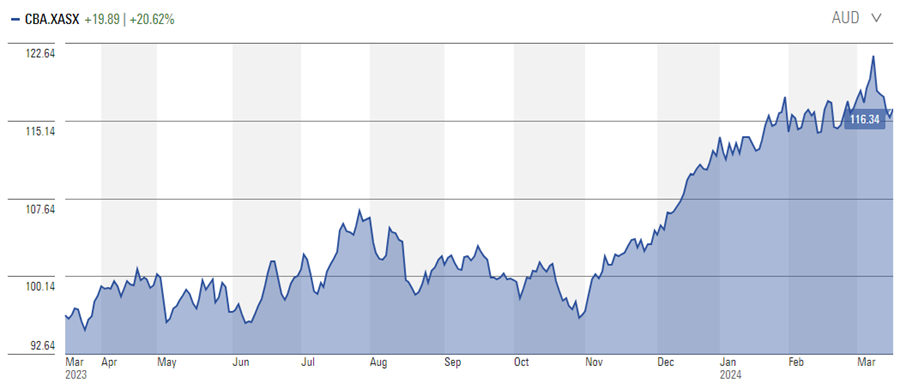

Source: Morningstar

The point is that there are extreme valuation differentials in markets today and being passive (through index investing) is not the way to take advantage of them.

A further valuation anomaly

Another valuation extreme is the US dollar.

Having visited the United States twice in the last three months, it was quite stark how significantly prices have increased post-Covid and, in Australian-dollar terms, made you feel like a pauper.

Nominal prices are pretty much the same as Australia but after adding the 10% state tax, the 4% charge they now automatically put on your bill for the kitchen staff, then the 25% tip the waiter is expecting and converting into Australian dollars, the price is twice what you pay in Australia. So, an average pizza and beer at an average sports bar, is approximately A$80.
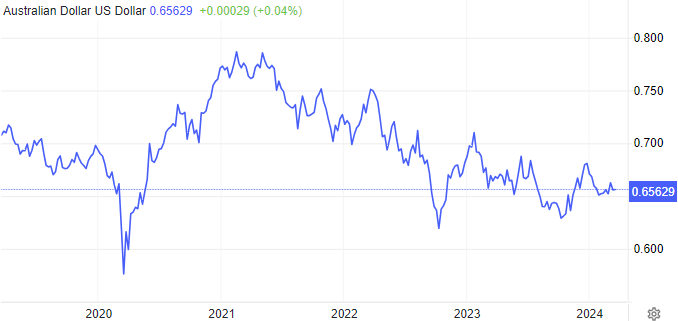

Source: Trading Economics

In another anecdote on the impact of Covid and why inflation is embedded in the system, I walked into a convenience store to get a bottle of water. I went to the counter to tap with my card and, before I tapped for the final amount, the machine asked if I would like to tip 20, 25 or 30%. No thanks…


Paul Moore is the founder and Chief Investment Officer of PM Capital. The information herein may change without notice, does not constitute advice or a recommendation, and does not take into account the objectives, financial situation or needs of any investor which should be considered before investing. Consider the PDS and Target Market Determination available at www.pmcapital.com.au and seek financial advice prior to making an investment decision. Past performance is not a reliable guide to future performance. The return of capital, or rate of return, is not guaranteed.


*As at 29 February 2024.
^Market capitalisation of ASX:CBA as at 19 March 2024 is $195 billion, source: ASX


  •   20 March 2024
  • 3
  •      
  •   

RELATED ARTICLES

Australia lags global dividend bonanza

Why the ASX 200 has gone nowhere in 16 years

LICs vs ETFs – which perform best?

banner

Most viewed in recent weeks

Warren Buffett's final lesson

I’ve long seen Buffett as a flawed genius: a great investor though a man with shortcomings. With his final letter to Berkshire shareholders, I reflect on how my views of Buffett have changed and the legacy he leaves.

13 ways to save money on your tax - legally

Thoughtful tax planning is a cornerstone of successful investing. This highlights 13 legal ways that you can reduce tax, preserve capital, and enhance long-term wealth across super, property, and shares.

The housing market is heading into choppy waters

With rates on hold and housing demand strong, lenders are pushing boundaries. As risky products return, borrowers should be cautious and not let clever marketing cloud their judgment.

Why it’s time to ditch the retirement journey

Retirement isn’t a clean financial arc. Income shocks, health costs and family pressures hit at random, exposing the limits of age-based planning and the myth of a predictable “retirement journey".

Taking from the young, giving to the old

Despite soaring retiree wealth, public spending on older Australians continues to rise. The result: retirees now out-earn the young, exposing structural flaws in the tax system and challenges for fiscal sustainability.

Welcome to Firstlinks Edition 637 with weekend update

What should you do if you think this market is grossly overvalued? While it’s impossible to predict the future, it is possible to prepare, and here are three tips on how to best construct your portfolio for what’s ahead.

  • 13 November 2025

Latest Updates

Investment strategies

Howard Marks: AI is "terrifying" for jobs, and maybe markets too

The renowned investor says there’s no shortage of speculative investors chasing AI riches and there could be a lot of money lost in the process. His biggest warning goes to workers and the jobs which will be replaced by AI.

Property

The 3 biggest residential property myths

I am a professional real estate investor who hears a lot of opinions rather than facts from so-called experts on the topic of property. Here are the largest myths when it comes to Australia’s biggest asset class.

Retirement

Australia's retirement system works brilliantly for some - but not all

The superannuation system has succeeded brilliantly at what it was designed to do: accumulate wealth during working lives. The next challenge is meeting members’ diverse needs in retirement. 

Retirement

Retirement affordability myths

Inflated retirement targets have driven people away from planning. This explores the gap between industry ideals and real savings, and why honest, achievable benchmarks matter. 

Retirement

Can you manage sequencing risk in retirement?

Sequencing risk can derail retirement, but you’re not powerless. Flexible withdrawals, investment choices and bucketing strategies can help retirees navigate unlucky markets and balance trade-offs.    

Retirement

Don’t rush to sell your home to fund aged care

Aged care rules have shifted. Selling the family home may no longer be the smartest option. This explains the capped means test, pension exemptions and new RAD exit fees reshaping the decision.

Shares

US market boom-bust cycles - where are we now?

This gives comprehensive data on more than 100 years of boom and bust cycles on the US stock market - how the market performed during these cycles, where the current AI uptick sits, and what the future may hold.

Property

A retail property niche offers a lot more upside

Retail real estate is outperforming as a cyclical upswing, robust demand and constrained supply drive renewed investor interest. This looks at the outlook and the continued rise of convenience assets. 

Sponsors

Alliances

© 2025 Morningstar, Inc. All rights reserved.

Disclaimer
The data, research and opinions provided here are for information purposes; are not an offer to buy or sell a security; and are not warranted to be correct, complete or accurate. Morningstar, its affiliates, and third-party content providers are not responsible for any investment decisions, damages or losses resulting from, or related to, the data and analyses or their use. To the extent any content is general advice, it has been prepared for clients of Morningstar Australasia Pty Ltd (ABN: 95 090 665 544, AFSL: 240892), without reference to your financial objectives, situation or needs. For more information refer to our Financial Services Guide. You should consider the advice in light of these matters and if applicable, the relevant Product Disclosure Statement before making any decision to invest. Past performance does not necessarily indicate a financial product’s future performance. To obtain advice tailored to your situation, contact a professional financial adviser. Articles are current as at date of publication.
This website contains information and opinions provided by third parties. Inclusion of this information does not necessarily represent Morningstar’s positions, strategies or opinions and should not be considered an endorsement by Morningstar.