Register For Our Mailing List

Register to receive our free weekly newsletter including editorials.

Home / 519

Inflation: A rare SMSF consideration

SMSF investors continue to face inflationary pressure not seen in decades. And it could influence investment performance if the potential effects are not considered.

It has been more than 30 years since the Consumer Price Index (CPI) reached 7%. The effects of rising inflation and subsequent central bank interest rate decision making were plain to see by the end of 2022. Having surprised markets by another 25bp hike in June, the RBA noted in their recent statement, that while inflation in Australia has passed its peak, it is still too high and that it will be some time before it is back within their target range of approximately 2-3%. And the Governor noted upside risks to the inflation outlook has increased and “the path to achieving a soft landing remains a narrow one”.

Additionally, the vulnerability of global capital markets from negative shocks remains. The most recent example being the collapse Silicon Valley Bank (SVB), coupled with Credit Suisse a few days later. Investors started to call into question the stability of the banking industry which helped move gold over the US$2,000 level, and coupled with a weakening FX rate, gold recorded its highest ever price in Australian dollars on May 4, 2023, at A$3,052/oz.

2022 and H1 2023 returns from major assets in Australian Dollars*
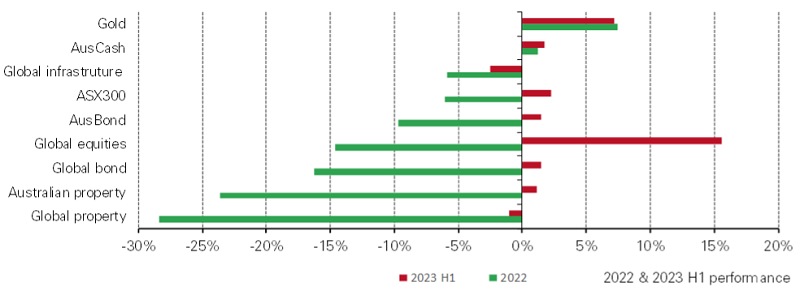
Source: Bloomberg, World Gold Council. *As of 31 December 2022. 2023 Y-t-d refers to 30 June 2023. Based on LBMA Gold Price PM, AusBond Bank Bill Index, AusBond 0+ Composite Index, Bloomberg Barclay Global Agg, ASX300 Index, MSCI World Index, ASX300 A-REIT Index, FTSE EPRA/NAREIT Developed ex-Australia Index, FTSE Developed Core Infrastructure Index. All calculations are in AUD.

Where could this lead?

With the upside risk to future inflation rising and local economic outlook dimming, the traditional warning signs of stagflation exist. Stagflation is defined as an economic cycle characterized by slow growth and a high unemployment rate accompanied by high inflation. The most notable period in Australia occurred in 1975 when a recession begun after the price of oil quadrupled.

In addition, the global geopolitical landscape is potentially hindering economic recovery efforts worldwide. The ongoing situation in Ukraine, and tensions between the US and China, might continue to impact financial markets. Over the coming 18 months elections in the US and EU are scheduled. There is additionally the prospect of the UK, Russia and Ukraine going to the polls. All of these events pose risk to the fragility of the economy with some being higher than others.

What should an SMSF investor be considering?

Does your SMSF have enough protection over stubborn high inflation and other possible market events? While property is a stable long term inflationary hedge, it has had considerable setbacks over the past 24 months. Additionally, the sustained interest rises imposed by the RBA to combat inflation, may pose challenges  Property is illiquid too meaning that while the long-term return on investment will still remain positive, it cannot help to hedge portfolios in the short and/or medium term.

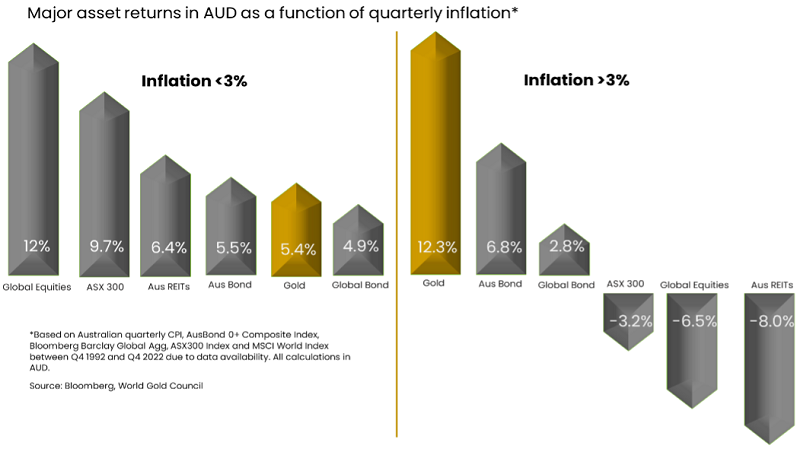
Another inflationary hedge asset, which is often overlooked by some SMSF investors, is Gold. It has long been considered the hedge against inflation and market events. It can also provide accessible liquidity if and when needed. Historical data confirms its status with an annualised return of 7.6% in AUD over the past 20 years, it has outpaced the Australian and world CPIs even in calmer economic times.
And should stagflation arise?

During stagflation periods, financial markets have seen heightened volatility while both commodities and gold fared well. Historical data reveals that investment portfolios have benefited from gold’s attractive returns during such periods.
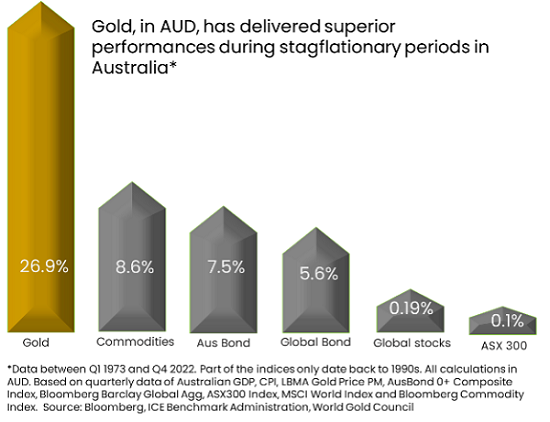
As aforementioned potential risks arise, gold may have a significant role to play over the coming years to help protect and sustain portfolio performance. Our recently published investment update concluded that a portfolio comprising of assets typically held by an SMSF would have achieved higher risk-adjusted returns and lower drawdowns with an allocation to gold over a 3, 5, 10 and 20-year period.

At the very least, SMSF investors should review their existing investment strategy and ensure that it has the right protection over high inflationary pressures, and to gain a greater understanding how it could potentially perform should stagflation hit home.


World Gold Council is a sponsor of Firstlinks. This article is for general informational and educational purposes only and does not amount to direct or indirect investment advice or assistance. You should consult with your professional advisers regarding any such product or service, take into account your individual financial needs and circumstances and carefully consider the risks associated with any investment decision.

For more articles and papers from World Gold Council, please click here.


  •   26 July 2023
  • 7
  •      
  •   
7 Comments
Pete Z
July 28, 2023

Historically, gold has been more correlated (inversely) to the US dollar, then being correlated to inflation. And in the 1970s, while physical gold performed well, gold equities didn't.

Gold probably deserve a place in a portfolio wanting inflation protection, though value shares warrant a larger share given them acting as a good inflation edge and are arguably undervalued right now.

SMSF Trustee
July 29, 2023

I will never ever hold physical gold in my portfolio. If I was truly worried about long term inflation I'd buy inflation linked bonds that pay me an income (gold doesn't) and guarantees that my nominal investment value will go up in line with inflation (gold doesn't).

Shaun
November 05, 2023

TIPS - This is not the case. Yes, the bond is adjusted for CPI, but the problem is the bond price will also adjust for the change in the yield curve. Therefore, your nominal and real returns may not be positive. Look at the TIP returns for the EURO Area, UK, and the US recently. Moreover, look at the returns from TIPS in Turkey.

Graham W
July 31, 2023

I believe gold should be part of every portfolio, no need for income it has very good appreciation in value over time.l
Only hold it in your SMSF if you don't have the funds to hold it outside super. If you have it in your fund exclude it's value from any management fee.

SMSF Trustee
August 01, 2023

It is part of mine, but via equity funds that invest in gold stocks. If the price appreciation is so good, then why not leverage it?

Gee whiz, I get sick of the gold bugs touting their commodity as if we should concentrate our portfolios into something that we have to own on a wing and a prayer that it will go up in value!

Graham W
August 01, 2023

Mine is a sensible allocation to gold and gold stocks, not a concentration. BTW my gold sovereigns are up 800 % since the mid 90,s and bullion held has doubled in the last ten years when inflation was 2% pa. It's a bugs life.

brammo
August 03, 2023

Warren Buffett doesn't think much of gold as an investment - that's good enough for me !


Leave a Comment:

RELATED ARTICLES

Why your portfolio should consider 5% gold

Investors need to look beyond bonds for safety

The diversification illusion: why 'balanced' portfolios may be exposed

banner

Most viewed in recent weeks

Noel Whittaker’s take on the budget

Marketed as a fix for inequality and housing affordability, the latest budget instead delivers a tangle of tax changes that leave everyday Australians worse off.

Australia has no death duties. Technically.

Australia may not levy formal death duties, but a growing web of tax measures is quietly shaping what wealth passes between generations. Now, the 2026 budget adds another layer.

How to minimise tax with a will

Inheritance tax implications in Australia may surprise some, as poor estate planning without proper wills or trusts can lead to costly tax bills and delays for beneficiaries.

Testamentary trusts post-budget: Estate planning, tax reform and the ‘death tax’ debate

Proposed Budget changes to taxation are casting new uncertainty over testamentary trusts, prompting closer scrutiny of estate planning structures and the real implications of reforms still taking shape.

Back to the future - Why indexing CGT is a good idea

A return to indexation of capital gains would be a fairer way to compensate households for the effects of inflation than the current discount. Importantly, it opens the door to future, broader reforms to stop the taxation of inflation.

The investment mistake killing your returns

Retail investors face an increasingly complex product environment, but simplicity may be the most overlooked advantage in building a portfolio you can actually live with.

Latest Updates

Investment strategies

Choose your hedges wisely… and often

A new market regime is exposing the fragility of static hedges. With correlations shifting and safe havens flipping, investors must rethink diversification and adopt more adaptive tools to protect capital.

Investment strategies

Yields take centre stage again

The Australian credit landscape is shifting. Yields are rising, issuance is strong and spreads continue to tighten. Income is re‑emerging as the dominant driver of returns, though pockets of risk may be building beneath the surface.

Investment strategies

The grass is always greener: Rethinking Australian vs global equities

Australia's once‑dominant sharemarket is losing ground as others surge ahead, prompting investors to question home‑bias instincts. Meanwhile, the US market appears attractive. Is it time to revisit your global equity allocation?

Investment strategies

Stop asking if there's a stock market bubble. Ask this instead.

Markets continue to push onwards despite valuations looking stretched by historical standards. Bubble talk is rampant, however investors may be focusing on the wrong thing. The real story sits deeper than the headlines.

Taxation

The GST cannot stop inflation

Raising the GST when inflation jumps sounds clever on paper, until we examine how it may play out in practice. What is pitched as a simple inflation fix can lead to a sharp turn in the wrong direction for prices.

Shares

Why SpaceX is coming to your super fund

SpaceX’s blockbuster debut is grabbing headlines, but the real story for Australian investors is much quieter. Giant listings eventually filter into super funds and ETFs, subtly reshaping portfolios long before most realise.

Taxation

Is the government being honest with us about its business CGT changes?

The government’s assurances on small‑business concessions don’t withstand the scrutiny. Token carve‑outs and a lack of credible rationale for CGT changes may reshape how Australia rewards long‑term value creation. 

Sponsors

Alliances

© 2026 Morningstar, Inc. All rights reserved.

Disclaimer
The data, research and opinions provided here are for information purposes; are not an offer to buy or sell a security; and are not warranted to be correct, complete or accurate. Morningstar, its affiliates, and third-party content providers are not responsible for any investment decisions, damages or losses resulting from, or related to, the data and analyses or their use. To the extent any content is general advice, it has been prepared for clients of Morningstar Australasia Pty Ltd (ABN: 95 090 665 544, AFSL: 240892), without reference to your financial objectives, situation or needs. For more information refer to our Financial Services Guide. You should consider the advice in light of these matters and if applicable, the relevant Product Disclosure Statement before making any decision to invest. Past performance does not necessarily indicate a financial product’s future performance. To obtain advice tailored to your situation, contact a professional financial adviser. Articles are current as at date of publication.
This website contains information and opinions provided by third parties. Inclusion of this information does not necessarily represent Morningstar’s positions, strategies or opinions and should not be considered an endorsement by Morningstar.