Register For Our Mailing List

Register to receive our free weekly newsletter including editorials.

Home / 222

Latest LIC and ETF updates

In Australia, Listed Investment Companies (LICs) and other listed trusts now total about $34 billion, and Exchange Traded Funds (ETFs) have reached about $30 billion. Both have established themselves as mainstays in the portfolios of many individual investors and SMSFs.

In our Education Centre, Cuffelinks publishes regular updates on LICs here and ETFs here.

Listed Investment Companies

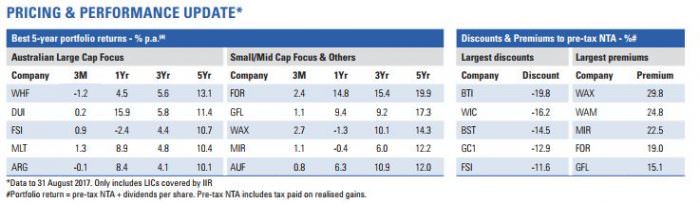
The latest monthly report from Independent Investment Research includes its full set of recommendations, plus this summary of the recent reporting season:

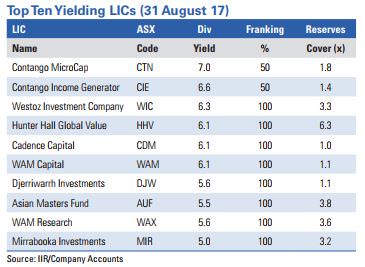
"Few LICs reduced their dividends during the recent reporting season despite many reporting lower earnings. This reflected the fact that most LICs have a level of profit reserves that enables them to smooth dividends by holding back when profits are strong. Our key measure for assessing LIC performance is total portfolio return, being growth in pre-tax NTA plus dividends, however, we understand that many investors in LICs are also focused on receiving attractive, fully franked dividends. So this month we take a look at the 10 highest yielding LICs in our coverage universe and consider the outlook and sustainability of these dividends.

In order to be able to pay dividends, LICs need to generate profits. However, it is possible for LICs to pay out more than they generate in profits in a given year by dipping into retained profit or dividend reserves from prior years. So it is possible for LICs to smooth dividend payments to their shareholders by retaining profits rather than simply paying out 100% of earnings each year. The table below shows our estimates (based on published accounts) of the number of years each LIC could retain its current dividend payments without generating any additional profits. This is a good indicator of dividend sustainability when markets turn down. Coverage of one means that a LIC could maintain its current dividend payout for one year without generating any profit in the current year."


Exchange Traded Funds

The latest monthly report by BetaShares includes this summary:

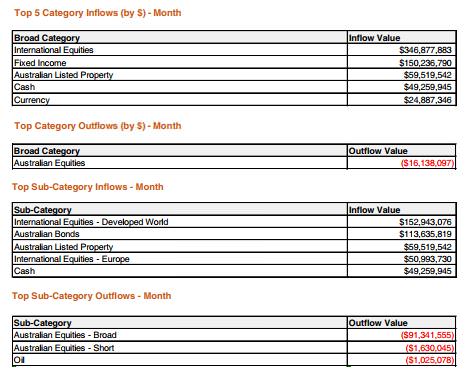
The Australian ETF industry recorded another strong month of growth, with the industry rising to a fresh record high:

• Total industry FuM at the month end was $30.9B, growth of 2.2% or $842m for the month

• While asset appreciation aided industry growth, the majority (75%) of the month’s growth came from net new money

• Unlike most of the year so far, which has seen strong inflows into Australian equities, the category with the highest level of inflows this month was global equities which received net inflows of $350m

• Australian bonds continued to received inflows with investors remaining cautious regarding the Australian sharemarket

• With continued macro-environmental instability gold exposures performed strongly this month with gold miners ETFs providing investors with the best performance for the month of August 2017.
  •   8 October 2017
  • 1
  •      
  •   

RELATED ARTICLES

ETFs are the Marvel of listed galaxies, even with star WAR

Finding opportunities in listed global funds

Four ways to invest in the same fund and save money

banner

Most viewed in recent weeks

Building a lazy ETF portfolio in 2026

What are the best ways to build a simple portfolio from scratch? I’ve addressed this issue before but think it’s worth revisiting given markets and the world have since changed, throwing up new challenges and things to consider.

Ray Dalio on 2025’s real story, Trump, and what’s next

The renowned investor says 2025’s real story wasn’t AI or US stocks but the shift away from American assets and a collapse in the value of money. And he outlines how to best position portfolios for what’s ahead.

13 million spare bedrooms: Rethinking Australia’s housing shortfall

We don’t have a housing shortage; we have housing misallocation. This explores why so many bedrooms go unused, what’s been tried before, and five things to unlock housing capacity – no new building required.

21 reasons we’re nearing the end of a secular bull market

Nearly all the indicators an investor would look for suggest that this secular bull market is approaching its end. My models forecast that the US is set for 0% annual returns over the next decade.

Making sense of record high markets as the world catches fire

The post-World War Two economic system is unravelling, leading to huge shifts in currency, bond and commodity markets, yet stocks seem oblivious to the chaos. This looks to history as a guide for what’s next.

3 ways to fix Australia’s affordability crisis

Our cost-of-living pressures go beyond the RBA: surging house prices, excessive migration, and expanding government programs, including the NDIS, are fuelling inflation, demanding bold, structural solutions.

Latest Updates

Property

How cutting the CGT discount could help rebalance housing market

A more rational taxation system that supports home ownership but discourages asset speculation could provide greater financial support to first home buyers.

Investment strategies

The Ozempic moment for SaaS

Every investing cycle has its Ozempic moment, a narrative shock so compelling that the market briefly forgets that incumbents can and do adapt to transformative technology like AI.

Superannuation

Meg on SMSFs: Last word on Div 296 for a while

The best way to deal with the incoming Division 296 tax on superannuation is likely doing nothing. Earnings will be taxed regardless of where the money sits, so here are some important considerations.

Investment strategies

If people talk about a bubble, it’s unlikely to crash soon

It is almost impossible to identify a bubble in real time, and history shows they last far longer than we think, giving investors (perhaps misplaced) hope and short-sellers seemingly endless pain before the share price collapses.

Investment strategies

Seismic shifts that could drive private markets

Dealmaking appears to be on the mend, but investors could be well served to look through near-term trends toward six major themes that we think may drive private markets for years to come.

Latest from Morningstar

Corporations are winning the stock market. Here’s a new plan for everyone else

Retail investors have the worst trading record, according to a study of trading performance. Institutional investors weren't at the top either. Here are 6 ways to improve your odds.

Infrastructure

The bull case for Melbourne

A counterpoint to today’s prevailing narrative that Melbourne is the capital of a failing state defined by its strained public finances, COVID hangover and an opposition obsessed with undermining its own credibility.

Sponsors

Alliances

© 2026 Morningstar, Inc. All rights reserved.

Disclaimer
The data, research and opinions provided here are for information purposes; are not an offer to buy or sell a security; and are not warranted to be correct, complete or accurate. Morningstar, its affiliates, and third-party content providers are not responsible for any investment decisions, damages or losses resulting from, or related to, the data and analyses or their use. To the extent any content is general advice, it has been prepared for clients of Morningstar Australasia Pty Ltd (ABN: 95 090 665 544, AFSL: 240892), without reference to your financial objectives, situation or needs. For more information refer to our Financial Services Guide. You should consider the advice in light of these matters and if applicable, the relevant Product Disclosure Statement before making any decision to invest. Past performance does not necessarily indicate a financial product’s future performance. To obtain advice tailored to your situation, contact a professional financial adviser. Articles are current as at date of publication.
This website contains information and opinions provided by third parties. Inclusion of this information does not necessarily represent Morningstar’s positions, strategies or opinions and should not be considered an endorsement by Morningstar.