Register For Our Mailing List

Register to receive our free weekly newsletter including editorials.

Home / 663

Back to the future - Why indexing CGT is a good idea

Australia’s capital gains tax has been in the economic and political spotlight for much of the year, with a number of substantial proposals put forward for reform. Ironically, it turns out that the simplest and fairest path forward is the one where we wind the clock back to pre-1999 and directly remove inflationary gains through indexation.

The main proposals to reform the tax treatment of capital gains include a reduction in the discount, taxing assets at different rates, and removing the discount to replace it with cost-base indexation.

As previous e61 research argues, an indexation-based system would improve the current treatment of capital gains. By taking into account the unique circumstances of the investor, indexation is a fairer and less distortionary way of taxing capital gains.

This would be a significant reform, and even more so if it becomes the first step toward taxing capital income consistently with other income over time.

A coherent goal for an income tax is to tax increases in economic capacity – or real income – as a measure of someone’s ability to pay. Once this is recognised, the problem with the current capital gains system becomes clearer. The existing CGT discount, and many of the reform options proposed, do not consistently tax real capital income. Indexation does.

Consistency is not as simple as taxing every dollar received in the same way. The tax system recognises that income is the money that remains after subtracting the costs incurred to generate it. Businesses deduct operating costs. Individuals deduct work-related expenses. These adjustments are not concessions but are necessary to measure true income.

Inflation is a cost for holding savings. The capital gains discount recognises this and attempts to approximate this cost in a way that is simple to comply with and administer.

However, it just isn’t a good approximation. The correct discount depends on the rate of return on the asset – where assets with high rates of return are less exposed to inflation and require a lower discount.

As recent e61 research has shown, there is a large spread in capital gains returns. For example, among housing investors between 2008 and 2025 those with low returns (the bottom quartile) made at least a 1.6% real loss while those with high returns (the top quartile) made over a 5% real gain. Such a spread implies individuals would need very different discounts to account for inflation costs, something that the current 50% discount and many of the proposed reform options fail to account for.
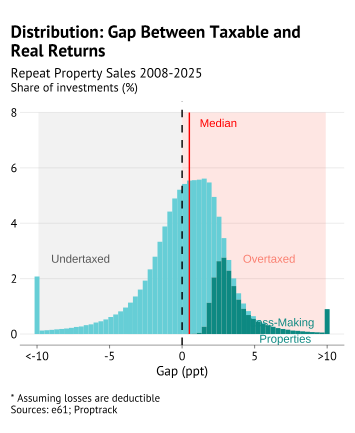
For this reason, cost-base indexation – increasing the cost base by a measure of inflation – would more accurately capture the real capital gain than a flat-rate discount. Such an approach allows for variation in inflation exposure across assets and holding periods – thereby ensuring that individuals are taxed on their full real capital gain, no more, no less.

How to tax capital income like wages

An equivalent way of understanding indexation is that it is an attempt to tax a form of capital income like wages. As shown in our e61 tax calculator release, indexation is necessary to ensure the real income from labour and capital are taxed the same way.

However, as our Submission to the Senate Select Committee on the operation of the capital gains discount highlighted – in the absence of inflation – there were two other reasons why the treatment of capital gains needs to be adjusted.

  • Ensuring symmetry: if only real returns are taxed due to indexation, then only real financing costs should be deductible. The failure to do so encourages excessive borrowing as outlined in our note on housing leverage.
  • Smoothing taxation over time: capital gains are lumpy, which means that they end up taxed at higher rates than if they were smoothed over time. This either encourages strategic avoidance/timing or is simply inequitable. Allowing some form of income-averaging/accrual treatment would mitigate this.

The logic of inflation adjustment, symmetric treatment, and smoothing doesn’t just apply to capital gains, it also applies to all types of capital income. When inflation erodes the real value of an asset, part of any nominal return simply compensates for that loss. Taxing this component is equivalent to taxing a cost. It results in an effective tax rate on real returns that can be far higher than intended, and in some cases can lead to positive tax liabilities even when real returns are negative.

If we genuinely want to tax wages and capital income consistently, we need to start by measuring both on a comparable basis. For wages, the tax base is already close to a real measure of income, as it reflects payments for current labour rather than the revaluation of past savings. For capital income, achieving the same requires explicitly adjusting for inflation.

An inflation, leverage and timing neutral system

These three principles are reflected in our proposal for an ILT-neutral (inflation, leverage and timing neutral) system for taxing capital income, including capital gains. This proposal only taxes the real component of capital income, only allows real financing costs to be deducted, and smooths volatile sources of income for assessing tax liabilities.

There are also arguments for going further. A large literature highlights that the 'normal' rate of return to capital should not be taxed. When a saver chooses to invest rather than spend, they require a minimum 'normal' return simply to make that deferral in consumption worthwhile. Taxing this component is, in effect, a tax on the decision to save rather than any gain from it. Under this approach, only returns above this normal rate would be taxed.

This can be implemented through an allowance for a normal rate of return, applied uniformly across assets. Conceptually, this would simply extend the inflation adjustment: instead of excluding just inflation, the tax system would exclude both inflation and the risk-free real return, taxing only excess returns.

The key point is that reform of capital gains taxation is just a first step in a broader evaluation of the taxation of capital income. Once we recognise that the objective is to tax real income, it becomes clear that the broader system for taxing capital income requires a more coherent and consistent framework.

Recent engagement on tax policy – through the Senate inquiry, Allegra Spender’s tax white paper, and the McKinnon tax summit – reflects a growing community appetite for meaningful tax reform, and a willingness to move past the narrow winners-and-losers framing of past debates. A shift to indexation would meet part of that demand.

Governments are often critiqued for a lack of engagement on tax policy. However, this time has been different. Its willingness to listen and encourage public debate has led to a richer understanding and evaluation of capital gains taxation alternatives.

Greater engagement by the public, a government willing to hear varying positions, and a broader civil society willing to make good faith arguments about tax policy are all positive signs for future tax reform. In this context, any reform announced in the upcoming budget should be seen not as the end of the conversation, but as the start of a longer program of repair.


Matt Nolan is a Senior Research Manager at the e61 Institute. His research is focused on analysing income distributions using microdata, with a focus on how taxes, transfers, and changes in labour market settings influence the distribution of income. Matt previously worked at the Inland Revenue Department of New Zealand and as a teaching fellow at Victoria University of Wellington. He holds a PhD in Philosophy (Economics) from Victoria University of Wellington.


  •   20 May 2026
  • 61
  •      
  •   
61 Comments
Oompaloompa
May 24, 2026

Middle/ upper class entitlement is alive and well in Australia. It’s a pity that vested interests have the deepest pockets, the loudest lobbyists and the biggest non news media owner.
Disclaimer- I am one of the mid/upper class members who has taken advantage of the huge taxpayer funded subsidies of negative gearing, cgt discount, div imputation, salary sacrifice etc etc.

2
Peter Taylor
May 25, 2026

In goverment what gets rewarded gets done by the influence of a system so called and amazingly legal accepted political donations grey gifts and lucrative post politics positions from the beneficiaries of policy. The system of goverment needs to change

1
Sammm
May 24, 2026

So , as a self funded retiree who has a small share portfolio and who trades a a little for fun . Ie $1000- $5000 the question will be as to whether to continue.

1
Vic Ciscato
May 21, 2026

The Government seems to be hiding behind the premise that the new CGT will in some way help young people to enter the housing market. My grandkids are at the University at present, and they have a savings mentality encouraged by their parents, have casual jobs, to help with the education fees and any left over is being invested in small parcels of shares and ETF's. At some point in the future they will decide to enter the property market and sell the growing portfolio and pay 30% CGT on realised gain after indexation. If individuals who take initiative to build wealth independently are penalised at the point they attempt to convert those investments into a home deposit, the policy undermines its own objectives.

34
Paul
May 21, 2026

I believe the proposed CGT is not 30% after indexation but I may have misunderstood the proposed changes. I thought it was indexation only and if this reduces the CGT to less than 30% then a minimum rate of 30% applies.

5
Ben S
May 22, 2026

Incorrect, it’s a minimum 30% CGT rate of indexation were lower than that and then it’s goes up from there in line with the person’s marginal tax rate up to 49% including the Medicare levy. So CGT is 30 to 49%, even on $100 sale of a minor parcel of shares.

11
George Gilchrist
May 21, 2026

I think we need to encourage people to invest in other assets than property. Too much money has been put into residential property, when after all a home is where we can have a roof over our heads and have some security and peace of mind going forward. Keep the 50% on all assets outside of residential property. Therefore including the shares & ETF's mentioned above, as long as they are held for more than a year.

5
Lauchlan Mackinnon
May 21, 2026

That's a very wonky point to make.

It fails when applied to businesses as an asset, because the initial value of the asset when the founder creates it is zero. A different logic should apply there, and that's a philosophical question not an economic one: what is a fair level of taxation of capital gains for a business asset that started from nothing, employed people, had the employees and founders paying tax on salary and profits, built the economy, all in the face of risks, and really should that be treated in just the same way as a residential property investment?

In general, there is no compelling case for saying prima facie that capital and wages should be taxed at the same rate. Among other factors, capital assets are bought with post tax income which was already taxed, and in whatever regime we are discussing it will be taxed again. Again, this is a philosophical question about asset classes and their treatment - NOT an economic efficiency question.

But putting that aside, for the government to sell it in a compelling way, they should:

* Recognise that this indexing approach penalises high growth assets more than low growth assets - and high growth is exactly the primary objective for most investors in the accumulation phase
* Recognise that this will disadvantage specific groups. It will take away advantages that baby boomers have had for over a quarter of a century, and Gen X, Geny, Gen Z and following generations will not have. This creates generational tax inequality.
* Recognise that this is being done by stealth, after promising not to do it a year ago, denying they are doing it for the last six months and saying that if they did, it would only apply to residential property, and saying hey, now we've announced it we need to push it through yesterday with no debate! Major broad-ranging changes like this should be given ample time for debate - preferably in the lead up to an election, where they can win a mandate for the change.

If the government doesn't address those concerns, then what's best or not from a wonky point of view seems kind of irrelevant ...

Also, if we're really going to return to the Keating era system, then lets return to it properly - including the ability to smooth out capital gains over five years before taxing it. Lets include the bits that benefit investors as well.

29
Nick
May 21, 2026

Very good response but too kind to the author who ignores investment risk and investor behaviour in his considerations. In fact wages income has little risk - if you don't get paid, you withdraw your labour. The (philosophical) question is: should capital investment be encouraged or not? If capital investment is just a pass-time, then tax profits like wages. But if we do want to encourage investment (from after tax dollars and at-risk borrowed funds), then how do we do this? A CGT of up to 47% does not encourage investment and exploits those who have risked their time, effort and capital. If inflation is the only risk to be compensated, then we may as well leave our money in the bank and avoid other risks all together - including sovereign risk this government has shone a spotlight on.

18
Lawrence
May 21, 2026

Well said. The risk premium is a key consideration that the so called experts and economists (and Treasurer Chalmers, who is neither) ignore when claiming that it is equitable to tax capital and labour in the same manner.

More broadly, the recent Federal budget is nothing more than the current government needing to balance the books after gross over expenditure and trying to pass it off as their noble attempt to cure intergenerational equity (whatever that is).

25
Ben S
May 22, 2026

We should also be asking what is a fair level of taxation not just to businesses but also to income and to capital gains. The reason Australians flock to capital gains producing assets is become the personal income tax rates over $135k at 39% including Medicare and over $190k at 49% including Medicare are punitive. Earning $135k or even $190k does not make you a wealthy person. So if someone wants to reduce their tax they borrow to invest so the borrowings are offset against their income to reduce their tax rate. The aim would be to come closer to the company tax rate of 30%. The memes produced showing Albanese taking 47% of someone’s new business when they sell it illustrate the same problem. Tax is too high. I think our highest marginal tax rate is at lease $100k to low and similarly the second highest is about $50k too low. The only way to solve these problems is for government to reduce waste spending. You cannot tax your way to prosperity. We are really pushing down on people financially through high taxes. This used to be the country of the fair go. You can’t have a fair go if you are working so hard and paying so much in tax.

10
Tim
May 22, 2026

Well put Lachlan McKinnon - sensible analysis and there is not sufficient philosophical discussion here of the ‘raised earth’ approach to taxing different income sources

5
Errol
May 21, 2026

“Governments are often critiqued for a lack of engagement on tax policy. However, this time has been different. Its willingness to listen and encourage public debate has led to a richer understanding and evaluation of capital gains taxation alternatives.”

OMG, where did this come from? There has been so little consultation by this government with stakeholders and that doesn’t even touch on the broken promises. e61 Institute really showing it’s Labor ties here.

26
Stephen E
May 22, 2026

The government is not even going to allow a period of serious discussion before it is voted on.

8
Vivan
May 25, 2026

Lol..."round table" discussions of academics and treasury officials wearing colourful glass frames. Why do they now need to consultant if it was so well debated? I suppose if was same process used for franking dividends and more recently "unrealised gains". Flawed logic can't be rationalised.

James#
May 21, 2026

Hot off the press in the AFR 21 May 26 : ‘I’m selling’: Investors could pay 50pc more tax than Treasury says"

Investors with diversified share portfolios making a mix of gains and losses compared to inflation could face tax rates of more than 100 per cent on real gains, due to the Albanese government not compensating investors for underperforming stocks.

A former senior Treasury tax official and a hedge fund manager both warned that people with a diversified portfolio of shares could face tax rates 50 per cent higher than Treasury calculated.

Private hedge fund manager and former NSW government economist Derek Francis said he had sold $400,000 of shares in the last few days after realising the full implications of the government’s capital gains tax overhaul for the sharemarket.

“I’m selling,” Francis said. “It is completely uninvestable outside of superannuation under the new tax settings.
“Individual stock picking and diversification is stuffed under this framework, particularly for more volatile small caps and miners other than maybe BHP and Rio.”

As an example, for an investor with a total $10,000 investment in the big four banks ($2500 each) over the last 20 years to 2026, only Commonwealth Bank of Australia has outperformed the inflation rate, excluding dividends.
The average real capital return of the portfolio was 1.1 per cent a year, or $1250 in total, after discounting for inflation.

Under the new system, tax payable on sale of the shares would be $1850, $600 more than the real gain. This is calculated for an investor on the second-highest marginal income tax rate of 39 per cent.

Only nominal losses, where the share price actually declines in absolute value, will be permitted to be offset against real gains.

Former Treasury and Australian Taxation Office senior official Geoff Francis said individual investors with a diversified portfolio of shares would not be able to offset real losses from underperforming stocks against the tax paid on over performing shares.

“The effective tax rate probably goes up by about 50 per cent on average,” Geoff Francis said.

“You will typically pay more tax than the Treasury numbers suggest because the only way you get the Treasury numbers is if you invest in an indexing tracking stock.

“It is worse the more diversified you are, particularly if you have some high-risk stocks where most underperform but a few outperform.”

“The Treasury model assumes you only invest in one share and it always beats inflation to get the benefit of indexation,” Derek Francis said.

Good investors with diversified portfolios typically had about one-third of their shares underperform inflation, he said.

Derek and Geoff Francis are brothers with backgrounds in economics, and both independently reached similar conclusions.

Derek is a former chief economist at the NSW Parliamentary Budget Office.

Geoff Francis said his former colleagues would be unlikely to allow people to offset real – inflation adjusted – losses against real gains because it would cost the government tax revenue.

“In a downturn people would sell to crystallise their losses and be able to index them in the future.”

Chalmers’ office and Treasury were contacted for comment on Thursday about whether real losses would be indexed to inflation.

Under another example, an investor buys shares in Coles and Woolworths, with one outperforming inflation and the other underperforming inflation.

The overall real return is zero after inflation, but the investor would pay tax on the winning stock.

If an investor instead bought an ETF of supermarkets with the same overall result, they would pay no tax.

Derek Francis said the CGT overhaul would deter stock diversification and encourage companies to pay out more in dividends, rather than investing for growth.

“It completely deters investments in high-risk, high-return firms,” he said. “Tech firms and mining explorers are stuffed under this.”

Seemingly, it gets worse by the minute! Nice one Jim!

22
Richard Lyon
May 24, 2026

Yes, a true "real return" tax regime would deduction real (rather than nominal) losses. However, in the supermarkets example, the new tax basis still delivers a lower tax bill than the current regime for someone with at least a 30% marginal tax rate.

For example, consider investments of 100 in supermarkets A & B, both sold when CPI has increased by 20%. A shares sell for 110, while B shares sell for 130, for a total nominal gain of 40 but a real gain of 0.

Under the new regime, there is no taxable gain on A but a taxable gain of 10 on B, for a total of 10. But the current regime has a taxable gain of 5 on A and 15 on B, for a total of 20.

And if inflation were much higher (or the returns on each were much closer to inflation), the contrast would be starker. For example, if A grows to 150 and B to 170, with CPI growing to 160, the new regime taxable gain remains 10, while it would now be 60 under the current regime.

Commentary elsewhere suggests that low-growth, high-income shares are the typical non-super holdings of Australian retail investors. If that's true, they will benefit from this change, imperfect though it may be.

Mjm
May 21, 2026

Well interest should be the same - tax applied after removal of inflation

18
JoanG
May 22, 2026

Good point! Why isn't taxation of interest income indexed?

13
Dudley
May 22, 2026


"Well interest should be the same - tax applied after removal of inflation":

30% minimum tax, or tax rate according to income band?

2
GeorgeB
May 25, 2026

"30% minimum tax, or tax rate according to income band?"

If tax is applied after removal of inflation it may not make much difference if real interest rates are tracking near enough to zero.

Errol
May 21, 2026

Isn’t the e61Institutes co-founder Andrew Charlton a Labor MP? No surprise any comments from them align with the Labor Party’s tax policies

17
Lauchlan Mackinnon
May 23, 2026

FWIW, apparently Andrew Charlton (a Minister for Labor) conceded that small businesses founded by someone are adversely impacted by the CGT change as (like startups) they have a low / zero cost base. That's good progress. It's covered in the weekend papers.

JanH
May 21, 2026

I've crunched some numbers, as they say, and the result is that low income people who invest in shares, both young and old, including self-funded retirees who didn't have super in their working lives, will be taxed at a higher rate than their marginal tax rate because unlike the current system, the capital gain tax cannot be less than 30%; that is, a minimum 30% tax is added to your taxable income if your marginal tax rate is below 30%. Regarding older Australians, this will affect women who were paid less than men in the same job, e.g. a female teacher, had to resign if she married, and was typically in and out of the workforce due to children.
For Chalmers to say all share income is passive income is disingenuous. Long-term investors must work hard to calculate the risks they bear in investing in shares and which to buy. As well, these Mum and Dad shareholders are investing their money into companies who employ people and produce things. Unlike investing in property, this benefits the economy. What I fear is that it will no longer be profitable for companies to list on the ASX. We've seen so many good companies privatised or USA-listed. The Australian market is shrivelling and this can't be good for our economy.

16
AndyB
May 21, 2026

My wife and I are self-funded pensioners who have paid all required tax over many years during our previous employed life. We have a small Allocated Pension that we plan to supplement from our share portfolio.
The portfolio was mainly established from my retrenchment payment. It is invested entirely in growth shares and, after several years, is happily showing some growth. We intended to sell part of the holding each year so we can subsist without being any kind of burden on the government.
Now, with the latest budget we find that the gain on any such sale of shares will be taxed at 30% from the first dollar. With any other kind of income, including share dividends, bank interest etc, the amount earned is added to taxable income then taxed at whatever rate is determined by the tax scales. There is a tax-free $18,200, then tax at various defined rates.
Why is the sale of shares treated any differently than income from other sources? Why should it be treated as taxable from the first dollar? How will this help any younger person to buy their first house? All it will do is provide a disincentive to invest and will drive me to a claim for the Age Pension.
I can cope with the change from a 50% discount to a CPI calculation, but this taxation of 30% from the first dollar is an iniquity that can only be politically motivated.

14
Dudley
May 21, 2026


"Why is the sale of shares treated any differently than income from other sources?":
Labor wants to punish the share owning poor class traitors, thinks extra tax will keep them loyal?

"There is a tax-free $18,200, then tax at various defined rates.":
For SAPTOer couple, 2 * 31,887 is tax free.
28.5% tax in next $1.

"a claim for the Age Pension":
Guild the stairs, empty the bucket list, apply for full Age Pension. More income unless you have > ~$2M.

5
James#
May 22, 2026

The 30% min CGT bypasses the $18,200 tax free threshold!

Have $0 taxable income, but sell a long held asset for a real gain of $18,000 and pay $5,400 tax (unless you hold a pension card)!

Someone's celebrating, but if you're not smiling it's probably the ATO!

11
GeorgeB
May 23, 2026

"Labor wants to punish the share owning poor class traitors, thinks extra tax will keep them loyal?"
"The 30% min CGT bypasses the $18,200 tax free threshold! "

Which may be another way of saying:
If you're going to invest like a capitalist we're going to tax you like a capitalist!

3
James#
May 23, 2026

"If you're going to invest like a capitalist we're going to tax you like a capitalist!"

Roger Montgomery wrote an excellent article in The Australian on May 22 titled: "Labor’s attack on wealth triggers a big fallout for investors and markets". Worth a read.

From the article, a worthy quote from Maggie Thatcher from 1992 about the nature of socialist governments is pertinent:

“The fact is Labour are still socialists and they deliberately set out to impose more government control over people’s lives. That is where their whole belief starts. It starts with the power of government over the lives of the people.

"That is why, that is the reason why they increase taxation. More power for them over our money, less power for the citizen. That is why they multiply controls and bureaucracy. More power for them, less for the wealth creators of our country.

“That is why they like nationalisation, more control over industry. That is why they reject privatisation and wider share ownership. That is why they want more council housing, because they want to have more control over the lives of the housing of the people and to use it for political purposes.”

Swollen bureaucracy (25% increase in commonwealth public service), more power to corrupt unions, institutionalised childcare (no parental choice), more and more taxes, debt and deficit for the next decade at least.........

6
Allan
May 22, 2026

Totally agree AndyB. The 50 percent discount always seemed a bit arbitrarily random to me, and provides outsized rewards to short term speculators. The indexation has more logic to it.

But levying a flat tax rate of 30 percent on the post-indexation gains is obscene. If one were to put their money in unproductive term deposits and similar, they could earn around $180000 before their progressive tax rates averaged out at 30 percent.

Once again the Government seems to be relying on lack of financial education in the general population, and sadly even the financial media, to play a sleight of hand that conflates capital gains with the tax rate applied to legal structures such as companies and that proposed for trusts.

Of course the politicians have ensured their larger than the community average property holdings can continue to be negatively geared in perpetuity. Yet a young person on a low income unavoidably receiving some of their annual ETF distributions in the form of realised capital gains will be liable, after a very modest adjustment for inflation, for the same tax hit as an income earner on around 180k.

Unethical, inequitable, and a disincentive to direct investment funds into the more productive end of the investment spectrum.

I don't honestly know if it is deliberate duplicity, stupidity, or more likely some combination of both.

15
GeorgeB
May 22, 2026

"deliberate duplicity, stupidity, or more likely some combination of both"

The only thing that is "deliberate" with this and many labor governments is the over-spending which is done in the full knowledge that they can come after "wealth" when the time comes to "pay the piper". The Victorian government did it with land and vacant residential taxes and now the federal government is doing it in the name of so called "inter-generational fairness". I would not want to be a long term renter in Victoria if these "reforms" pass into law.

5
Marcus
May 22, 2026

I have been investing for over 40 years. Every now and then you get on a rocket ship...I am on one now with potential gains of $600000 on a $10000 investment. Anyone who tells me that I should pay $200000 in tax is joking. I have had this stock since IPO around 10 years. Taken all the risk and the Govt want a third of the return. Under previous rule I would still lose $100000. This is theft ....This Socialist Government are dogs. Anyone and many did buy the IPO whether 20 years of age or 60 as in my case. Equal opportunity...so I pick a winner and get penalised as does the 20 year Old. There is absolutely no fairness in these new rules for anybody. As a self funded retiree this money would flow back into the economy instead of into a halfarsed Government Scheme.

10
Mick
May 24, 2026

Marcus, congratulations on a terrific investment decision. The calculated risk taken all those years ago was, no doubt, paid with monies on which taxes had already been levied. As the investor, you took all the risk. But Chalmers and his mates are like the blokes who turn up for the beers after all the heavy lifting has been done. It's a hallmark of Socialist governments to exercise the politics of envy. As a Gen X, I have real concern for my young adult children who are both working hard and investing what they can to provision for their own futures, and to not be a burden on other taxpayers. As young people, neither subscribe to or are fooled by the government's concoction of "intergenerational inequity". And, I never heard my grandparents, who lived the Great Depression, snivel about such things (and if ever there were a generation entitled to do so, it was those poor souls who rolled out of the Great War and into a Great Depression). Prolifigate spending, big government is running out of cash and is coming for ours. One can only imagine how much greater the quagmire would be if all Australians adopted their governments largesse in their own domestic budgets. Don't mistake this as a rant against tax, which are critical to essential service delivery. It is , however, railing against an incompetent Socialist government who time should have been over before it started.

2
GeorgeB
May 25, 2026

"As young people, neither subscribe to or are fooled by the government's concoction of "intergenerational inequity"

This falsehood may go down as one of the most egregious con jobs in Australian political history to justify imposing taxes which the socialist left has long coveted. No one I have met has been able to explain why houses were so much more affordable precisely during the years (ie. prior to 1985) when both negative gearing and 100% CGT discount were available to residential investors. Any takers?

1
Dudley
May 25, 2026


"Any takers?":

Real net interest rates and credit rations mattered more than negative gearing or CGT discount?

'In the early 1980s, Australia’s financial system was characterised by strict, government-imposed regulations, meaning banks could not freely compete on interest rates. This created systemic credit rationing, where the available supply of loans fell far short of demand, forcing banks to ration credit by keeping customers waiting in "borrowing queues" or strictly allocating funds only to clients with the most pristine credit records.'

James#
May 23, 2026

Back to the future - Why indexing CGT is NOT a good idea!

Labor’s plan to change CGT back to a worse version of the pre-1999 indexation method has some insidious flaws and exposes good reasons why it was changed. (beyond setting a min 30% CGT and not allowing averaging of gains over 5 years)

The new proposed system will now tax only the returns you earn above the rate of inflation, at between 30% and 47% on the capital gain above this inflation-linked benchmark. All well and good.

However, Labor will not allow you to deduct your inflation-adjusted losses, or so-called “real” losses, to offset these taxable gains.

Under the old system, capital losses offset gains. Under the new proposed system inflation-adjusted gains will be taxed at up to a 47% rate, but inflation-adjusted losses will not reduce this liability (only nominal losses will).

For example, if you have two stocks (substitute any asset here), that have been held for years.

Stock A appreciates in value from $100 to $200. At the same time, inflation has added up to a total of 20%. Your after-inflation (real capital gain) is therefore $200 less $120, or $80.

On stock B, you lost money: you paid $100 and sold it for $90. Your nominal capital loss is considered to be $10. But inflation was 20% over this holding period, so your after-inflation loss is actually $120 minus $90, or $30.

Under the old tax model, you would pay a maximum of 23.5 % applied to the net total capital gains across the two investments. That is $100 less the $10 capital loss, or $90, multiplied by 23.5 per cent, which gives a tax liability of $21.15.

If the new model were fair, it would allow you to do the same thing in inflation-adjusted terms: net your real capital loss off against your real capital gain.

In the example, the capital return above inflation on stock A was $80. The capital loss on the second investment after inflation was $30. Your net inflation-adjusted capital gain is therefore $50. You would then pay 47% tax on this $50, which gives $23.50 of total tax. This is an 11% increase in your tax bill relative to the old model.

The new system does not allow you to deduct inflation-adjusted losses. You can only reduce your gains with the nominal (rather than inflation-adjusted) loss – that is, $10. Accordingly, your inflation-adjusted net capital gain falls from $80 to $70, not the $50 it should be if they were being fair. And then you get whacked with 47% tax on this gain, which is $32.90.

This is a 56% increase in your tax bill compared with the old approach!!!

It makes holding direct investments via a diversified portfolio of individual shares very unattractive and encourages the use of ETFs and super funds. In an ETF, all the nominal gains and losses are netted and distributed. Super funds are exempt from indexation altogether: they get a one-third CGT discount in accumulation and no CGT at all on gains realised in the pension phase.

Australia’s top capital gains tax rate of 23.5%, which was introduced via the CGT discount, put us in line with global peers. There are 10 to 12 OECD countries that have lower rates. Some, like NZ and Singapore, have no CGT at all. We will have the highest maximum CGT rate in the world, and we will end up with among the highest average CGT rates as well.

The changes are an unjustified, unfair attack against capital investment and taking risk, by not allowing you to index your losses. It is a system that will crimp investment, especially investment in innovation.

This is not good for Australia and Australian companies (that employ people) and will drive entrepreneurs and capital overseas. It will push investors away investing in (providing capital for) higher-growth, innovative (riskier) start up companies.

Australia will stagnate even further, becoming a stale, tired economy, lacking innovation and scaring capital away to capital friendlier countries!

Their gain, our loss!

10
Dudley
May 23, 2026


Treasury and Treasurer should be examined for Brain Fog.

Brain Fog Tests:
. Gross up $1 of dividends for 30% company tax.
. Gross up $2 of dividends for 30% company tax.

1
GeorgeB
May 21, 2026

"Yes, it doesn't make sense for highly leveraged property investors, for example, to be able to deduct the full nominal cost of borrowing when only the real capital gains return is taxed. "

This argument ignores the fact that capital gains accrued over many years are lumped into a single tax year thus ensuring that most of the gains are taxed at the highest marginal rate. A fairer way would be to spread the gains over the same period that the asset was held.

It also ignores the fact that while the cost base of the asset is indexed for inflation, rental losses are frozen in nominal terms so that the real value of future tax relief is steadily eroded by inflation over time. A fairer way would be to index the rental losses so that the value of tax relief is not eroded by inflation.

8
James#
May 25, 2026

Peter Costello in the AFR 25 May: "Labor is trashing the CGT discount it supported in 1999"

"The government is pushing an investment penalty that will punish young people trying to build wealth, rather than solve housing issues. This is a new tax on investment.

Let us be clear, this is a new tax on investment – all investments. It is cynical marketing to suggest it is being done to help young people. Make no mistake; the young will suffer under this more than the old. The young will have a lifetime of these higher taxes. They will never have the same opportunities their parents had – or indeed those that members of the Albanese cabinet had – to save, invest, and keep a decent share of the proceeds.

This whole dispiriting episode began in deception. The prime minister, by his own reckoning, ruled this out 50 times before the election. To keep it a secret, it was drawn up furtively. The details couldn’t be aired or examined. The hidden operation meant ministers had no clear understanding of the implications. Now they find it hard to back down.

Let us contrast this with the way the current system was introduced.

Before the 1998 election, the then-Coalition government announced its tax proposals in detail on indirect tax (GST) and income tax – rates, thresholds, benefits, excise rates, price effects. Everything.

After it had been minutely scrutinised in a hotly contested election, the government moved to implement it.

As also promised, John Ralph was commissioned to review the business tax system. That review released a consultation paper, held public seminars, took submissions (more than 300) and finally recommended a 50 per cent discount on capital gains tax.

I supported that recommendation. As did Labor. That’s right, Labor supported the 50 per cent discount method. It would not have gone through the Senate had Labor opposed it.

Why did we move to this system?

First, it is a rate comparable to those of like countries around the world, such as Britain and the United States. It made us comparable and competitive. The OECD average is around 20 per cent. The government wants to move our rates between 30 and 47 per cent.

No one in the government has been able to explain why Australia needs the highest investment taxes in the world.

Second, the current system is much simpler – simpler to comply with and simpler to administer. The record keeping involved in indexing cost base (including assets pre-1985, which have never been in the tax system before) increases complexity and compliance costs.

The supposed revenue to be gained from this will never be realised. This is designed to reduce the reward for risk. People will rearrange their affairs accordingly.

Which brings me to the question of how much revenue this is supposed to raise.

The budget proposes two separate legislative measures: increased capital gains tax and restricting negative gearing. To try to deceive the gullible into thinking higher CGT is a housing measure, the two are lumped together and costed as one measure in Budget Paper 2. In all my years drawing up budgets and reading them, I have never seen an attempt to obscure the real nature of a proposal using a technique like this. It is obviously in breach of the Charter of Budget Honesty. It gives an insight into the mindset of those involved: to conceal the true nature of the measure.

Keating’s statement on the budget didn’t mention negative gearing. That’s an interesting omission because Keating abolished negative gearing in 1985. The consequences were so bad, particularly for renters, that Labor reintroduced it after two years. The current system operates under Labor’s 1987 legislation.

We shall see what happens to renters this time around

The changes to investment tax would leave us hopelessly uncompetitive with the developed world, and even more uncompetitive with the region. Singapore and New Zealand have a zero rate of capital gains tax. None, zip.

When these changes fail to produce an easy entry to home ownership, young people, rightly, will be more disillusioned than ever.

New charlatans will ply them with promises of cheaper housing under new taxes on the family home or new death duties. For the high tax brigade, the problem is never the issue. Whatever the problem, their answer is always the same: more tax.

But it’s not just investment taxes that stifle aspiration.

Income tax is suffocating aspiration too.

This government’s last move on the top threshold was to lower it to $190,000. It was $180,000 20 years ago when I left office. In today’s money, that would now be $280,000. Of course, penalising people on income tax means they try to invest to get ahead.

None of the proposed changes do anything about our high marginal tax rates that cut in at thresholds that are too low. It is high income tax, plus additional investment taxes.

And budget deficits as far as the eye can see.

These proposals are another step in our march towards a high tax, high debt, low productivity, low growth future. That will not help the young in the slightest."


6
Joanne
May 25, 2026

Costello nails why this budget is a deceptive ruse that actually harms young people in the long run. Should be required reading for everyone. What a terribly dishonest government we have!

4
Stephen
May 21, 2026

Thanks for the article Matt. It was informative and based on economic logic.

Unfortunately you’re writing for the wrong audience. Most of the replies were based on personal financial interest and emotion.

5
Lawrence
May 21, 2026

"The correct discount depends on the rate of return on the asset – where assets with high rates of return are less exposed to inflation and require a lower discount."

You may consider this to be "economic logic" but this ignores the fundamentals of human behaviour. If I invest in assets with high rates of return, I'm only doing so because I am willing to take on the risk associated with investing in these assets. If you apply a lower discount to these assets you are reducing the after tax rate of return on these assets while expecting me to take on the same level of risk. That is neither logical or rational.

10
Stephen
May 21, 2026

Lawrence, what you are suggesting is that high return/high risk assets should have a lower rate of tax than lower return/lower risk assets. That may be reasonable for start ups where the risk is very high - because most fail - and the definition of a start up is very clear.

But it is not reasonable to widely implement differential rates of tax based on perceived risk. To do so would require someone in government judging the risk of every investment. Do you want that?

Here’s the solution. If you find the after tax return too low for the risk don’t invest in the asset. If many do this the price of the asset will fall, thus adjusting the risk/return trade off.

2
Lauchlan Mackinnon
May 22, 2026

Re "You may consider this to be "economic logic" but this ignores the fundamentals of human behaviour." - exactly, that's economics in a nutshell - ignoring human behaviour. That's why they had to invent a whole new and seperate branch of economics, behavioural economics" to try and patch up the broken and unrealistic foundations that neoclassical economics was built on.

Lawrence
May 22, 2026

Re "You may consider this to be "economic logic" but this ignores the fundamentals of human behaviour." - exactly, that's economics in a nutshell - ignoring human behaviour. That's why they had to invent a whole new and separate branch of economics, behavioural economics" to try and patch up the broken and unrealistic foundations that neoclassical economics was built on.

I know, I majored in economics in university. Even at that young and impressionable age I knew none of the course content bore any resemblance to the real world so I became a Chartered Accountant instead :-)

1
Lawrence
May 22, 2026

"Lawrence, what you are suggesting is that high return/high risk assets should have a lower rate of tax than lower return/lower risk assets"

No Stephen, I am suggesting that assets should receive the same discount regardless of their rate of return or risk profile. The original author seems to be suggesting otherwise - i.e. "The correct discount depends on the rate of return on the asset – where assets with high rates of return are less exposed to inflation and require a lower discount."

2
Stephen
May 22, 2026

"No Stephen, I am suggesting that assets should receive the same discount regardless of their rate of return or risk profile. The original author seems to be suggesting otherwise - i.e. "The correct discount depends on the rate of return on the asset – where assets with high rates of return are less exposed to inflation and require a lower discount."

Lawrence, the author is not suggesting that assets should receive differing discounts. He writes;

"Inflation is a cost for holding savings. The capital gains discount recognises this and attempts to approximate this cost in a way that is simple to comply with and administer.

However, it just isn’t a good approximation. The correct discount depends on the rate of return on the asset – where assets with high rates of return are less exposed to inflation and require a lower discount."

When he is refers to the "capital gains discount" in the second sentence above he is referring to the current 50% CGT discount. Note the phrase "simple to comply and administer"" (this was one of the arguments used to support the 50% CGT discount). In reference to the 50% CGT discount he writes "However it isn't a good approximation" (he is clearly referring to the approximation for inflation).

He then states, "The correct discount depends on the rate of return on the asset – where assets with high rates of return are less exposed to inflation and require a lower discount."

In the above sentence he is making the argument for indexation, although it's not the clearest way way to make the point. Perhaps he could have written something along the lines of;

Assets with high growth rates are "overcompensated" by the current 50% CGT discount as a substantial amount of the gain after inflation is not taxed. Paradoxically assets with low growth rates are "undercompensated" by the current 50% CGT discount as that discount can result in taxing part of the gain between the cost of the asset and its indexed value.

Indexation solves both these issues as only the gain after inflation is taxed.


1
Bruce
May 24, 2026

Matt,
You have caused quite a stir. Well done. But that's my last compliment.
For a start you are perpetuating the LIE that we are returning to the old system of capital gains tax. NOT so, when Keating introduced that it had an averaging period of (I think 3 or 5 years ). Somewhat fairer don't you think?
Secondly, it is entirely naive to suggest that this move is part of a master plan to make significant and fairer changes to our tax system. This is nothing but an ideological move against capital as opposed to income AND to wind back a Howard/Costello improvement to Keating's capital tax. If the motivation is, as you say, then why not at the same time, index the income tax thresholds to make "bracket creep' a non issue??
Thirdly, if you have indeed read the academic " literature" as you say, then you would know that there is much persuasive argument supporting the case for not taxing capital /investment/and even savings at all. In this respect Australia was until the 90's a capital poor country and after many big and small changes starting in the early 80's with paying interest on deposits under 180 days, we finally were able to accumulate enough capital domestically to reduce recourse to foreign debt markets every time we wanted to build something or dig a hole. This tax is a step backwards not forward.
Finally, I think it's a bit rich that you are happy to support a tax in Australia while you live in New Zealand which unless I've missed something does NOT have Capital GaIns Tax.

5
Alexander Stevens
May 22, 2026

Your statement that “Recent engagement on tax policy…reflects a growing community appetite for meaningful tax reform” is quite pathetic.

This has been a pre-meditated and carefully orchestrated sequence of ‘initiatives’ by the radical left Labor/Greens/Teals cohort to provide a dishonest licence for such misleading and deceptive statements and provide an apparent platform to further attack and destroy wealth creation in this country.

What a joke.

A heading titled “Why no CGT is a good idea” would be much more interesting and beneficial for us all.

4
BMC
May 21, 2026

Begs the question why do almost no countries using indexation any more?

3
RGB
May 21, 2026

and if you trying to solve a housing problem as Labour say they are (change the CGT ,limit the number of neg geared resi and slow immigration all of which will reduce demand and probably prices) . Leave tax unchanged for other productive investments (particularly business) to encourage productive investment ,employment and economic growth. I really hope this discussion does not simply find a solution for small business and leave larger long run business in a different tax regime .....every big business often started small , artificial cutoffs/thresholds will be a fail. AND I am not a business owner and I do not have negatively geared property

2
Hiker
May 23, 2026

If indexation is such a "wonderful" idea, why isn't it an option for pre-budget assets? I have held a unit for over 20 years, and while its value has nearly doubled, applying an indexation factor of 1.9 would result in zero CGT. This is only fair, as there has been no real gain in purchasing power.

Instead, I am forced to pay tax on 50% of a nominal $500k gain. This isn't tax reform; it’s robbery disguised as policy. Labor needs to go.

2
RGB
May 21, 2026

Seriously to inflation index a business investment with zero or low cost base (WITH MASSIVE RISKS TO GROW BUILD AND PROSPER, REINVEST..and many fail ) at the same rate as a resi property ..is crazy and wrong . Risk and reward go together

1
GeorgeB
May 23, 2026

My son, a software developer has just lost his job at a startup after about 5 years in the role - the startup has been in business for about 6 years-can't help thinking if he would still have his job if the Budget didn't target startups-anyway the damage has been done-thank you doctor Chalmers

1
JanH
May 24, 2026

I would like to see someone who is a qualified tax accountant calculate the impact of a compulsory minimum 30% CGT on those on the marginal tax rates,
2026 Tax free threshold (TFT) $18,200 Nil $18,201 – $45,000 16c for each $1 over $18,200
2027. TFT (NIL) plus 15c $18,201 and $45,000. and is reduced to 15%.
2027–28 TFT (NIL) plus 14c $18,201 and $45,000.

And regarding property investment, for those who game the system by making one house their PPOR and selling on 366 days (1 yr plus one day) so profit is CGT free, then buy another house repeating the process ad infinitum: they will escape CGT altogether. This ploy is favoured by the very rich and famous who buy a mansion for $5 million and sell after a year for $10 million. You see this all the time in the AFR Property reports. Chalmers has not addressed this nice little earner.
And, yes, as someone said earlier, most MPs have several investment houses. I wonder how many invest in ASX equities? Very few, I suspect. The MPs investment portfolios will be grandfathered. Is this not corrupt? Setting up a tax policy that benefits them!

Q1 Will the 30% minimum CGT wipe out the TFT? Some have suggested it will.
Q2 What will the real marginal tax rate be if a minimum 30% CGT is levied on taxable income at the 26,27,28 rates above?

1
Annabel
May 26, 2026

Can you explain how MPs receive different tax treatment? I read nothing in the budget papers about MPs portfolios being grandfathered. I'm not suggesting that they don't use the current rules to their advantage, but your post contains misinformation.

The Register of Members Interests is readily available as they are required to declare their, their partner's and dependent children's assets and gifts received. Note that Pauline has yet to declare the plane that Gina gave her earlier this year.

Tom
May 21, 2026

What you're calling for is a first principles reexamination of how capital income is taxed. Good luck with that. I do agree, just question practicality/realism. Yes, it doesn't make sense for highly leveraged property investors, for example, to be able to deduct the full nominal cost of borrowing when only the real capital gains return is taxed.

John
May 23, 2026

A couple of quick comments. Very good article thanks but requires a lot of thinking re full response. I need to research your e61.
The Ralph proposal had the stated objective of incentivising asset investment and simplifying. I think it was based around shares being higher risk than property and holding periods averaging around 4 years for shares and 7 years for property.
Pretty clearly the 50% rate to compensate for inflation was extremely crude. It clearly overcompensated shares with turnovers in 1-3 years. However, it probably undercompensates longer holdings of property. I think I’ve seen some reports of both under compensation and also of making little difference depending on time period and inflation.
While full indexation is likely the best approach, leaving aside simplification, the Keating averaging still resulted in real capital gains after averaging having some effect of being taxed at a higher rate than other income as in salaries and wages.
The Government proposal is around improving housing affordability for first-home buyers. I don’t see that this requires fiddling with CGT over shares. Further, since much of existing property in, say, Sydney is well outside the affordability of first-home buyers, I don’t see the point of part of the approach re existing property.
I note that the Government appears to be encouraging foreign investors to invest in rental style accommodation with an incentive yet there is no particular incentive to invest in new-builds for domestic investors.

David Adams
May 24, 2026

One thing that is overlooked is that the Small Business CGT Concessions have not been touched. This means that a business can be sold with little or no CGT if the conditions are met.

GeorgeB
May 26, 2026

If the govt wants to get a generous cut of personal assets that appreciate in value over time, then they should also get a generous cut of personal assets that depreciate in value over time (eg.most personal effects, motor vehicles, furniture, appliances, etc). Otherwise its a lot like: tails I win, heads you lose.


Leave a Comment:

banner

Most viewed in recent weeks

2 billion reasons to fix retirement income

A proposal to address Australia's 'stranded balances' in retirement by requiring super funds to transition members to pension phase at 65, boosting retirement income and reframing super as a source of income.

The ultimate superannuation EOFY checklist 2026

Here is a checklist of 28 important issues you should address before June 30 to ensure your SMSF or other super fund is in order and that you are making the most of the strategies available.

Do super funds need a massive wake up call?

UK retirement expert, Guy Opperman, believes super funds are failing at supporting members in deaccumulation. Here is what Australia should do about it. 

Two months into retirement

A retirement researcher's take on retirement and her focus on each of her six resource buckets to stay engaged during the transition and beyond.

Welcome to Firstlinks Edition 662 with weekend update

The debate over the budget is increasingly shaped by frustration and perceptions of unfairness, rather than clear-eyed assessment of policy outcomes.

How inflation is quietly moving the goalposts on retirement

Inflation doesn’t just raise today’s bills - it quietly increases the amount needed to retire, while simultaneously making it harder to save. Three steps to take before June 30th to improve retirement outcomes.

Latest Updates

Back to the future - Why indexing CGT is a good idea

A return to indexation of capital gains would be a fairer way to compensate households for the effects of inflation than the current discount. Importantly, it opens the door to future, broader reforms to stop the taxation of inflation.

Australia has no death duties. Technically.

Australia may not levy formal death duties, but a growing web of tax measures is quietly shaping what wealth passes between generations. Now, the 2026 budget adds another layer.

Strategy

The folly of the Iran war

From oil shocks to fractured alliances, the Iran war carries the hallmarks of a historic policy misstep - one that could tip an already fragile global economy into crisis.

Taxation

Noel Whittaker’s take on the budget

Marketed as a fix for inequality and housing affordability, the latest budget instead delivers a tangle of tax changes that leave everyday Australians worse off.

Investment strategies

The red metal's long game

Copper has had a rough few weeks but investors should not ignore the potential for future price increases as supply increasingly falls behind demand.

Taxation

The lesser-known effects of changed property taxes

The budget’s property tax reforms are being framed as fairness measures, but they risk splitting the housing market, penalising lower‑income investors and introducing distortions that may prove costly.

Latest from Morningstar

Why stocks sometimes fall for no obvious reason

The vast and opaque world of private assets is a powerful gravitational force - and when trouble hits, it's the more liquid public equities that often the feel it first.

Sponsors

Alliances

© 2026 Morningstar, Inc. All rights reserved.

Disclaimer
The data, research and opinions provided here are for information purposes; are not an offer to buy or sell a security; and are not warranted to be correct, complete or accurate. Morningstar, its affiliates, and third-party content providers are not responsible for any investment decisions, damages or losses resulting from, or related to, the data and analyses or their use. To the extent any content is general advice, it has been prepared for clients of Morningstar Australasia Pty Ltd (ABN: 95 090 665 544, AFSL: 240892), without reference to your financial objectives, situation or needs. For more information refer to our Financial Services Guide. You should consider the advice in light of these matters and if applicable, the relevant Product Disclosure Statement before making any decision to invest. Past performance does not necessarily indicate a financial product’s future performance. To obtain advice tailored to your situation, contact a professional financial adviser. Articles are current as at date of publication.
This website contains information and opinions provided by third parties. Inclusion of this information does not necessarily represent Morningstar’s positions, strategies or opinions and should not be considered an endorsement by Morningstar.