Register For Our Mailing List

Register to receive our free weekly newsletter including editorials.

Home / 663

Noel Whittaker’s take on the budget

On May 12, Treasurer Jim Chalmers handed down one of the most unpopular budgets in Australia's history. He claimed the Budget was about fixing intergenerational inequality and making housing more affordable for first-home buyers. Tell him he's dreaming.

For starters, the term "intergenerational inequality" is a social construct dreamed up by Labor to create a whole new class of victims they can encourage to vote for them. Yes, young people have challenges, as young people always have, but so do older Australians.

As for affordable housing, it's fast becoming a pipe dream. Even the Budget papers forecast housing prices will rise by 4% over the next year. A tax cut worth roughly $50 a week for younger workers is hardly going to help much when mortgage repayments keep climbing as interest rates rise. There also seems to be an assumption that the best way to increase housing supply is to make investing in residential property by individuals as unattractive as possible. Clearly, they've never heard the adage: "Money flows to where it's treated best."

Talk to any builder, and they'll tell you they're overworked, prices are going sky-high, and they can't get staff. Furthermore, they're held down by a web of red tape and bureaucracy. Just this week, a builder told me he had a block of apartments all set to go, but couldn't get the plan registered until the Brisbane City Council lodged their landscaping certificate. Can you believe it took the Brisbane City Council 12 weeks to lodge a simple certificate? That was 12 weeks of wasted time, which he said cost him over $200,000 in delayed settlements.

I can't see building prices dropping in this environment.

Capital gains tax

They claim the changes have been grandfathered, but in my view they are only partly grandfathered. Suppose you own a property now worth $800,000 that you bought 10 years ago for $400,000. You will get the 50% CGT discount if you sell the property by 30 June 2027. But if you sell after that date, two sets of rules will apply. A case study may make this clearer.

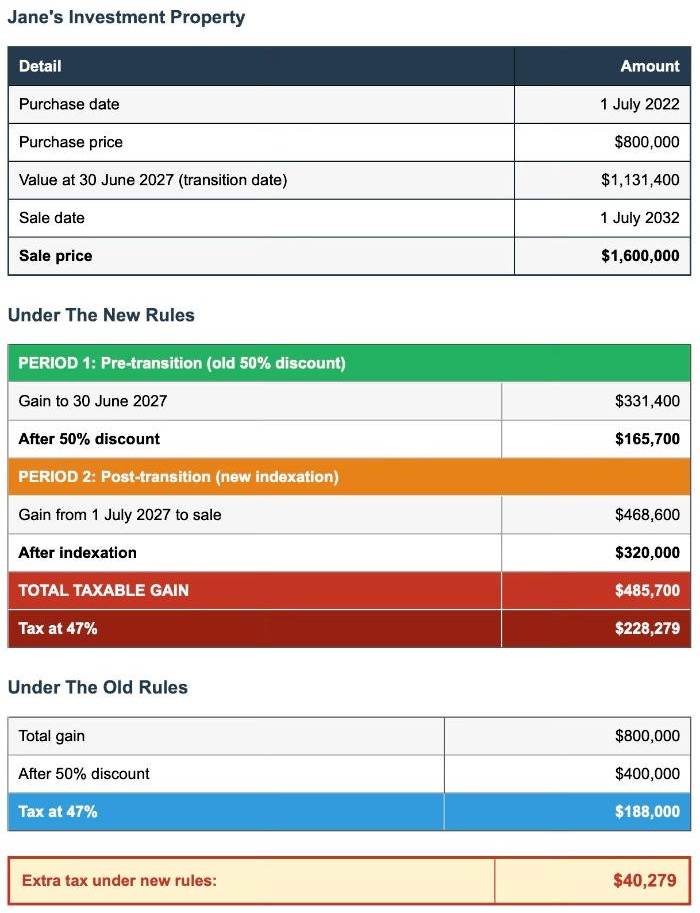
This example is from the Budget papers, but the numbers have been rounded to make it easier to understand. Jane buys a property on 1 July 2022 for $800,000. She sells it on 1 July 2032 for $1.6 million. Using what the department calls “ATO tools”, she discovers the asset was worth $1,131,400 on 30 June 2027, when the transition came into effect.

The difference between that value and her original cost price is $331,400, which reduces to $165,700 after applying the 50% discount. She then subtracts the 30 June 2027 value of $1,131,400 from the selling price of $1.6 million. This gives her a gain of $468,600 from 1 July 2027 until the property was sold on 1 July 2032. After indexation from 1 July 2027 until the sale date, the adjusted gain would be $320,000.

The total taxable gain is then the sum of $165,700 and $320,000, giving a taxable capital gain of $485,700, which would be added to her taxable income in the year of sale. The tax payable would depend on her other income, but if we keep it simple and apply the top marginal rate of 47%, the total CGT bill would be about $228,279.

Under the old rules, her gain would have been $800,000, which, after the 50% discount, would have reduced to $400,000. Tax at 47% on that amount would have been $188,000, which is about $40,000 less than under the proposed new rules.

I appreciate this is complex, which is why it is so important to get expert advice if you are even thinking about selling a CGT asset. They're summarized in this table to help you understand how it works.
Special treatment for pensioners: The $1 pension loophole

The Budget exempts anyone receiving even one dollar of "income support" from the new CGT rules. That includes pensioner couples with $1.054 million in assets who get a few dollars a fortnight in pension. They keep the full 50% CGT discount. No questions asked.

These same couples can earn $90,000 a year from work without losing a cent of pension. A single renter with no assets is treated in the harshest way imaginable.

Meanwhile, meet Jenny. She's 67, rents for $400 a week, and has no assets apart from a few dollars in the bank. She gets the full single age pension of $30,654 plus rent assistance of $5,616, giving her a total income of $36,254 a year. She considers a job paying $45,000. Sounds good, right?

Here's what actually happens. Once her income exceeds $218 a fortnight, she loses 50 cents of pension for every extra dollar earned. The Work Bonus gives her some temporary relief in year one, but after that it's gone. Her $45,000 salary costs her $13,780 in lost pension. Add $10,516 in tax, and the combined hit is $24,296. She's working full-time for an extra $20,704. That's an effective marginal tax rate of 54%. No-one else in Australia pays tax at that rate.

But a couple with over a million dollars in assets? They can earn $90,000 with zero impact on their pension—and now they're protected from CGT changes too.

The system protects the wealthy and punishes the poor. This Budget just made it worse.

The Trust tax bombshell

From 1 July 2028, family trusts will be hit with a flat 30% tax rate. The impact is brutal.

Bob and Mary run a small business through their family trust. They net $180,000 a year and distribute $60,000 to each of them, plus another $60,000 to their daughter Elizabeth. Tax on these distributions is about $9,000 each – a total of $27,000 a year.
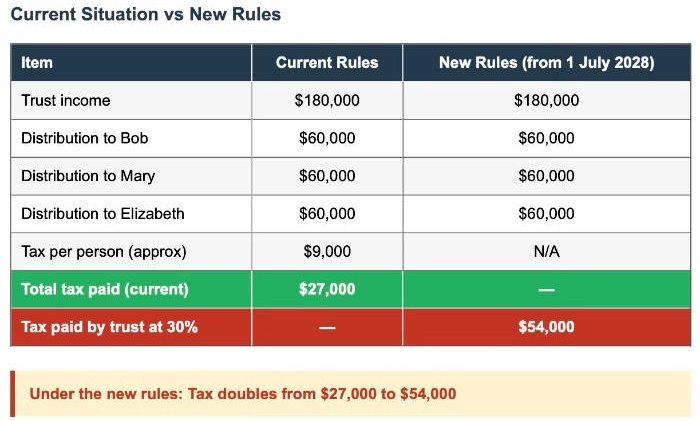
The way around this is to ensure the trust has no income itself, and the money is distributed to the beneficiaries in a different way.
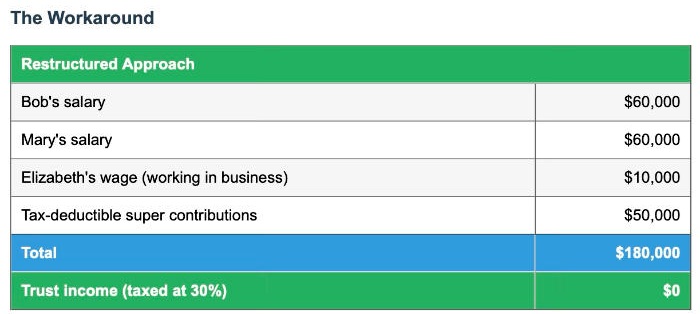
This is just one simple example, but it does show the importance of anyone with a family trust working closely with their accountant to optimize their taxation position before these changes take effect.

The death tax

There’s been plenty of media speculation about a possible death tax. Much of it appears to relate to potential changes to testamentary trusts, but that remains a grey area and experts are still waiting for details. But there is already a form of death tax effectively locked in: Division 296, the proposed tax on super balances above $3 million.

Take Jack and Jill. They each have $2.5 million in super, so neither is affected because both are under the threshold. Then Jack dies and his super passes to Jill, pushing her balance to $5 million and leaving her $2 million above the threshold and potentially exposed to Division 296 tax.

A death tax by stealth.


Noel Whittaker is the author of Making Money Made Simple and numerous other books on personal finance. His advice is general in nature and readers should seek their own professional advice before making any financial decisions. Email: [email protected].


  •   20 May 2026
  • 54
  •      
  •   
54 Comments
Jim Bonham
May 21, 2026

A bizarre feature of the new tax is the 30% minimum tax on CGT. The budget explainer "Negative Gearing and Capital Gains Reform" justifies this by saying it “reduces the benefit of taxpayers deferring capital gains realisation to years where their marginal tax rates are low”.
That's a rather surprising attack on the concept of progressive income tax scales. Technically, the statement is sort of true: the 30% minimum rate is definitely an extra burden on anyone realising a modest gain when their other taxable income is low – but that applies regardless of their tax rate at the time they bought the asset – they might not have had much income then, either. The unstated implication that this is punishment for those scheming property tycoons, or that it might influence their behaviour, is just nonsense.
For a start, the maximum effect of the 30% minimum occurs for someone (entitled to SAPTO) with a real capital gain of $36k, and no other taxable income. In that case it adds about $11k to the tax that would otherwise be payable under the new regime. For younger folk, the maximum tax effect is about $9k, for a real gain of $47,000.
No-one selling real estate is going to be influenced by the possibility of an extra $11k tax. The weather on auction day will be more important.
The people that the minimum CGT rate will really affect are those with a low taxable income and modest capital gains. For example: a retiree who doesn't quite qualify for an age pension; a student earning a small income part time and investing it assiduously; a young parent taking time off from the workforce while the kids are little, who owns a share portfolio jointly with their partner. For these people a thousand or two extra cash is material, and they are people you would expect Labor to protect, not exploit.

You really have to wonder what is going on?

44
Lawrence
May 22, 2026

Yes, I was somewhat perplexed by that. Coincidentally my financial situation is eerily similar to Jack’s. The example used in the budget papers. I’m a recent involuntary self funded retiree. Last year I paid CGT on my modest capital gains at my marginal tax rate of 16%. There is a good reason why I only paid marginal tax of 16% - I don’t have a lot of income, about $35k a year and had to sell assets that I’ve been holding for 20 years to cover the shortfall between my income and my expenses. Clearly, I’m not the rich capitalist fat cat that Mr. Chalmers thinks he is penalising.

In future I will be paying the minimum cgt tax of 30% if Mr. Chalmers gets his way. I do not need to run my numbers through a complex stochastic calculator to know that I’d be better off selling the assets I had saved to self fund my retirement, spending most of it (likely on an extension to my house) to get me to a position so I pass the Age Pension means test and live off the taxpayer for the rest of my life.

Is this the sort of behaviour the Government is trying to encourage?

22
Jim Bonham
May 22, 2026

I just want to correct a couple of technical points, which have no impact on the broader conclusions.

Firstly, the comparison of tax calculated with a minimum 30% rate for real gains versus the conventional calculation needs to be done before allowing for the Medicare levy, SAPTO or any other tax offsets. They're not relevant to the difference, as they are calculated from the total taxable income which is the same in each case.

Secondly, the maximum effect (if there is no other taxable income) is $9,200 based on 2025-26 tax rates, and it occurs when the real gain is between $45k and $135k, the range covered by the 30% tax bracket. Beyond that, the effect peters out to zero for real gains above $225k.

I should also point that that Tony Dillon and I (see his article in this edition) have different views about the mechanics of this calculation, but in either case the fundamental point above remains: the 30% minimum tax rate has an immaterial effect on the people at whom it is supposedly directed (sellers of real estate).

3
Chris S
May 21, 2026

I’m sorry, Noel, but I think you’ve got this all wrong. I’m a great believer in you (I have many of your books, thank you for all you have done for so many), and I generally trust your advice and experience.

There are two fundamental flaws in your anti-Chalmers budget diatribe. First, as you’ve acknowledged yourself, genuine tax reform is difficult. Indeed, in these polarised political environment, it’s pretty much impossible to redesign our system to remove all the inconsistencies and problems.

All that can be done now is to tinker here and there to try to adjust the most easily tackled issues. Anything more fundamental would be stymied by the loudest voices and far too many vested interests. I believe yours is one of those influential voices preventing more substantial reforms to our tax system.

The second flaw with your argument is that your examples show that people are now going to be so worse off. What you are doing is comparing the “before” to a period of time when such people were substantially better off than a fair system should have allowed them to be.

I have got to put my hand up and admit that I am also one of those who have benefitted from a system that has been rigged in my favour. I’m happy for the pendulum to swing back the other way. I just wish it could swing further, but it hits hard upon vested interests that are too strong to allow the wholesale redesign of a flawed tax system.

41
margaret gillett
May 21, 2026

Hear Hear I have participated in building wealth simply . No trusts etc I have enough and I am happy to pay tax. I have had friends and family set up complicated finances and are no better off they just pay for lawyers and accountants to avoid tax. Compounding and spending less than you earn will still work. At last someone with the guts to make change.

17
OldbutSane
May 21, 2026

I tend to agree, although I do think that the 30% minimum tax on CGT is a little unfair on those who do not receive any Government assistance and have low incomes.

The changes to discretionary trusts are long overdue.

17
Rod in Oz
May 21, 2026

Well said Chris S; I agree with you. Thank-you.
Too much greed and selfishness around.

8
Alex
May 21, 2026

The problem is that this government try to fix an issue by tinkering with taxation system only, even though the issue itself is not necessarily caused by taxation. The "fundamental" issue with housing affordability is the imbalance between demand and supply, which are impacted by many factors beyond just tax treatment.

Speculating (or accusing) the writer to be "one of those influential voices preventing more substantial reforms to our tax system" is rather low. For any individual who is "happy for the pendulum to swing back the other way" like yourself, there is another one who is completely unhappy with it - the irony is that many of the unhappy individuals happen to be the ones that Labor claim to be trying to help with this so called tax reform, as shown by the backlash they received to date from small business owners / aspiring property owners.

16
Roger
May 21, 2026

Whatever happened to the Financial Advisor's mantra?: 'Never invest in an asset class solely for its taxation benefit'
...Crickets

4
GG
May 21, 2026

Two things in his argument that are wrong? The first is that you see Noel has acknowledged that genuine tax reform is difficult. Can’t see how that is a flaw in Noel’s commentary.
Then the second flaw is you don’t like a before and after scenario. What do you think people want to see - some flag waving for the Government changes? People want to see how the changes will affect them. Full stop.
So Chris S, not sure that your arguments do anything but throw doubt on Noel’s opinion.
Not that helpful Chris S.

17
James#
May 22, 2026

"genuine tax reform"

You're joking right? The only person that thinks this is genuine tax reform is the self-glorifying Jim Chalmers!

Real tax reform would reduce income taxes (even Keating says more than 39% is theft), index the marginal tax brackets (the top tax rate cuts in way too low. Properly indexed should be not the of $270,000) and raise consumption taxes!

The deceitful ruse is that the changes proposed in the budget will significantly make housing more affordable. Rubbish! The primary determinants of housing affordability are supply and interest rates. Supply depends on building rates and immigration. Low building rates and high immigration are the biggest problem.

Persistent high inflation (much of it home grown) leads to higher interest rates, reducing borrowing capacity and the high inflation leads to much higher construction costs in both labour and materials. The circa 40% building/development cost attributable to governmental fees and charges doesn't help much either!

Labor's budget changes to both CGT and negative gearing are a naked tax grab under the thin guise of intergenerational equity mumbo jumbo that may at best alter the housing crisis a minuscule amount at the margins.

Big hat, no cattle !

27
Peter S
May 22, 2026

Hey Chris, I'm failing to see how providing a clear example and explaining the outcomes is a diatribe. In today's Australian, Henry Ergas has written an in-depth piece going back to Keating in the 80's to now. Covers the great Liberal and Labor treasurers, their legacy and compares to what we're grappling with now.

8
James
May 24, 2026

The changes hit young people hard re shares and CGT. Meanwhile re housing, the government continues to grow the uber driver migration program.

4
Jim
May 24, 2026

Well said Chris S. It’s frightening to me just how many greedy people are happy to accumulate wealth via generous tax minimisation arrangements and then whinge when the generous rules are changed. Society is better when all people contribute rather than the wealthy being able to accumulate more via tax avoidance and minimisation. I fully support this overdue reform.

2
Vonblake
May 25, 2026

Jim its critical that we don't compound an existing issue with a fix that is counterproductive. As James has noted the $80B tax benefit for Treasury is not going to wage earners rather redirected to hiring more public servants and funding the runaway NDIS. It's also hard to understand why a few here are labelling playing by the rules as "greed". We all want a more efficient system, but this reform will (and BTW already is) having the opposite effect.

Be Kind
May 21, 2026

I am hopeful that in the process of passing legislation for the budget, the ill-considered 30% minimum tax on CGT will die.

Have a young person in our household with no income successfully investing a small portfolio (savings for a future housing deposit). He is not on any welfare, so the 30% minimum CGT tax rule is cruel to him.

28
Lauchlan Mackinnon
May 21, 2026

I just want to second your point that "... the term "intergenerational inequality" is a social construct dreamed up by Labor" - at least as it applies to intergenerational TAX inequality.

The housing affordability crisis is real generational inequality.
The climate crisis is real generational inequality.

They deserve attention - and the action on negative gearing in the budget is a small step towards addressing the affordability crisis.

But there wasn't any generational tax inequality - everyone got the same tax regime when they got older and had more assets. Until Jim Chalmers and this budget. Now Gen X, Gen Y, Gen Z get a different tax regime, less advantageous than the baby boomers had for the last quarter of a century. That's generational tax inequality, thanks to Labor and Jim Chalmers.

23
Phillip Stewart
May 21, 2026

Irrespective of where you sit in relation to the budget tax changes, I find it very difficult to accept a flat 30% tax on the taxable component of capital gains. If they were taxed at marginal rates then there is a degree of equality between income derived from capital and income derived from labour. This is not the case with the proposed changes.

Secondly, I can accept the 30% tax on trust distributions but if, and only if, the 30% tax is refundable in the hands of the recipient beneficiary ie on the basis the income is taxed at marginal rates, not a flat 30%. In other words, in exactly the same way as the existing franking credit system works. This too would provide equality between the taxing of income from this source and income derived from labour.

I know this would never happen, but if things were fair dinkum then there should be an allowance for inflation on the taxation of interest. For instance if a term deposit earns 4% and inflation is 5% then the asset owner is going backwards. Just saying.

12
JoanG
May 22, 2026

Your last point is critical, Phillip. Interest income at 4% with inflation at 5% is indeed a capital loss in anyone's language, and more so when the interest is taxed and the capital loss disallowed. So why is taxation of interest income from cash investments not indexed?

11
Francis H
May 21, 2026

Noel, an excellent article as usual. You acknowledge that young people have challenges as they always have. Very true. When I purchased my first home in 1977 I had to get a loan from my parents to pay the deposit as many young people now have to. Getting a home loan was very difficult due to the laws at the time and very conservative bank managers. Women need not apply was the policy. Those same laws and attitudes today would see very few young property owners.

As for high prices today, the failures of Government over many years to address housing supply played a big part as well as immigration and property tax breaks. State and Local Government delays and charges also add very significantly to new housing costs. Nothing is going to magically change here. It is easier for a Council to charge high fees than to increase rates. The same for State Governments. Noel's example is spot on. Gough Whitlam could have taught Federal Government how to go about addressing housing supply properly.

The big problem with the proposed changes to property taxes is the 30% minimum as Tony Dillon so elegantly illustrates in his article of this edition. It is plainly regressive, everything Labor supposedly opposes. How did Chalmers and Albanese miss this ? It needs to be dumped. And Mr Chalmers needs to learn from past Treasurers that it is sometimes best to ignore your own Department. As Paul Keating did with superannuation.
Talking of Paul Keating, his involvement might be useful. He can advise the Government how to reverse course as he did with negative gearing. And also the cost of destroying trust in Government ( LAW tax cuts ).

12
OJP
May 21, 2026

Aro,
Issue 1 - proposed changes should have been part of the election campaign last year.
Issue 2 - latest budget is about increasing the tax burden with no meaningful attempt to reduce spending.

12
Sean Corbett
May 21, 2026

To answer Jim Bonham's final question, what is really going on is actually quite simple to explain at a political and societal and behavioural level.

The explanation is that Labor, as well as the Treasury, both understand that Labor needs to "exploit", not "protect", the poor because the gap between Labor's spending and the tax revenue Labor receives is simply too large to plug by taxing the few and diminishing number of the rich and that it is therefore necessary for Labor to get more tax from the large and growing number of the poor.

The other point to note is that Labor's spending, particularly on welfare and "cost of living" relief, is precisely what has led to the few and diminishing number of the rich by discouraging people from saving and investing to grow their wealth and has also led to the large and growing number of the poor by encouraging people to join their ranks because of Labor's spending on welfare and "cost of living" relief.

In other words, it is Labor itself that has intentionally created the few and diminishing number of the rich, as well as those who consider themselves comfortably well off or at least just comfortable, who are not traditional Labor voters, and has also created the large and growing number of the poor, who are traditional Labor voters.

That has been “achieved” through Labor's policies aimed at ensuring "intergenerational fairness" and their policies aimed at ensuring that "no one is left behind", which are policies that Labor has followed in order to favour and grow their own voting base and discourage those who don't vote for them so that Labor can remain in power.

Unfortunately, eventually Labor's policies become a self-reinforcing doom loop where "intergenerational fairness" is in reality achieved through ensuring that every generation is counted as being among the poor and that "no one is left behind" because they can't become poorer than anyone else.

That is the point Labor's policies appear to have reached now, hence why they had to resort to releasing the latest budget.

11
Acton
May 23, 2026

A change of mind or policy is not a lie if it's a well intentioned reaction to a change in facts or circumstances.
But a change of mind and policy is a lie when there has been no change of facts or circumstances.
In the case of these 2026 CGT, negative gearing and trust changes there has been no change of circumstances since before the election.
Housing was unaffordable then and still is, but these major and far reaching tax changes were not put to the electorate for consideration and the electorate never gave this government the mandate to make them.
These major and far reaching tax changes were not put to the electorate for consideration and the electorate never gave this government the mandate to make them.
Experts in finance and business are condemning these changes. Today's Australian Financial Review editorial: "These changes were picked apart by investment and tax experts who say the government is out of touch with reality." Another AFR headline: "A drive-by shooting on nation's prosperity".
The worst thing for the electorate is that these tax changes, due to the business inexperience or ignorance of tax revenue focussed Treasury officials who advised Chambers will negatively impact on Gen Z investors, aspiring home buyers, mortgage payers (if interest rates rise from inflationary government growth), property and share investors, businesses, tech companies, mining exploration, mortgage payers, retirees, and the beneficiaries of family trusts. And probably many more, if not all of us.
This budget was conceived on a lie and delivered in a cloak of deception.
Those who support these tax changes have the morality, ethics and wisdom of Pinnochio.

11
Geoff
May 21, 2026

I'd like someone to explain to me how a non-property asset, say a parcel of shares, owned for several years before 1Jul 27 and sold some years after 1 Jul 27 will be CGT assessed. I understand, the theory, I think, and the value of the shares at 1 Jul 27 is easily worked out, but it seems that the total amount of assessable CG depends hugely on the value on a particular day - 1 Jul 27, leading to different outcomes depending upon that value, which is a bit of a nonsense as the overall gain remains the same.

Imagine a parcel of shares worth $10,000 back in, say, 2020 which at 1 Jul 27 have dropped to a value of $5,000. Eventually a year or so later they appreciate for whatever reason and are sold by the long suffering investor for $10,000. There has been no capital gain, yet it seems the investor will have to calculate a loss for the first section and then a gain from an inflation-indexed capital base for the second section. I don't know how that calculation would pan out, without setting a sale date and the amount of CPI adjustment, but it seems a lot of work for something that hasn't actually made any money.

And if you think it can't happen, make me an offer for my TLS shares, please...

Maybe I have this all wrong - happy to be educated as to how this particular scenario would pan out.

9
John
May 21, 2026

Good point Geoff. I hadn't picked up on what is an unrealised value at 30/6/2027, which will of course have an effect on income for the later period using 30/6/2027 as the new cost base. However, hard to manipulate the value of shares on the final trading day of the year against all other manipulaters on that day. Also need a good forecast of future inflation to know if you want a higher or lower value at 30/6/2027.

Andrew
May 21, 2026

Sadly Noel your political alliance is all to naked in your rhetoric

9
GeorgeB
May 22, 2026

But your criticism also shows naked political alliance, does it not?

15
James#
May 22, 2026

Exactly! Quod erat demonstrandum (Q.E.D.), Bada boom bada bing or voilà!

7
Peter S
May 23, 2026

When you can't argue the facts, go for the person, politics or anything just to deflect - Is that right George?

2
GeorgeB
May 23, 2026

"When you can't argue the facts, go for the person, politics or anything just to deflect "

Way back in high school debating we learned that an "ad hominem" attack is a logical fallacy where you respond to an opponent’s argument by attacking their character, motives, or personal traits instead of the actual issue. Its still the go to tactic!

7
Graham W
May 21, 2026

My wife and I are in our late seventies and moved our financial assets from a SMSF to a Family Trust. The income was tax free in the SMSF and so were the pension payments. The SMSF got a refund for the franking credits. But the tax and reorganisation needed when one of us dies as a super fund beneficiary is really difficult. So moving to the Trust, our income is the same ,but taxable to us when distributed from the trust. The trust is not a vehicle to split income just a far better way to estate plan when we pass on. With SAPTO amd LITO ,we would pay little tax and benefit from the franking credits. Taxing the Trust at 30 % of it's income is an abomination and terrible legislation. The 30 % tax is not refundable and the franking credits only available to reduce the 30 % tax.
All we are trying to do is make it easier to manage our affairs and for our family to look after our finances if we lose capacity . I estimate that we will be markedly worse off than we are if this legislation is passed. I suppose we can pay ourselves interest on our beneficiary accounts to reduce the trust's taxable income to nil. We could then claim tax offsets against our interest income. However what happens to a trust with no taxable income, but has franking credits? Seems to be a goldmine for the accountants.

6
David
May 21, 2026

Graham, I sympathise with your situation. My wife and I are slightly older that you and still have our SMSF, but I have been wondering when to pack it in to avoid the death taxes that would otherwise accrue. Clearly putting the residual in a trust has been a disaster for you. I wish to provide a legacy for my 2 young adult grandchildren, neither of whom are working full time yet. I have to work out how not to leave them any capital gain liability, so that they are not hit with 30% tax at least until their own regular tax rate is 30% or above. That could take a while to happen, with the unemployment rate increasing now.

Graham W
May 22, 2026

Thanks David. Re the legacy one answer is Insurance Bonds, they are taxed at 30% but can be tax free when redeemed by them and growth investment opportunities available. I am spending a fair bit this year to make our house multiple use to accommodate a child with no home. Will probably pass on a similar amount to our other child and qualify for the pension in five years. A good incentive to keep healthy ???

GeorgeB
May 22, 2026

"without investment to provide the buildings and equipment for the job, there is no employment and no income"

This the hard reality that has undone many a socialist movement in the past. Its then a long road back to prosperity if at all.

6
John Wilson
May 21, 2026

I don't disagree with the change from 50% discount to indexation, but suggest there should be small addition to the CPI when indexing the cost base: that would provide some incentive to invest which Australia needs.
As well, the proposed indexation does not take us back to the Keating: that also provided for averaging of capital gains over 5 years to smooth out lumpy capital gains. As I recall, that also applied to primary industry where farmers have good and bad years. Without smoothing under our "progressive" tax scale, there is more income in the good years that is in in high rate tax brackets. Keating was a saint compared to the current lot!

5
Chris
May 22, 2026

Typical Labor!!! All smoke and mirrors and no real substance in their policies..you work all your life to provide for your retirement which means when you get there you hopefully do not have to rely on pensions etc and subsequently like myself do not impose a burden on the welfare state so that those more needy are looked after.What annoys me is that it seems like the ATO and the government is penalising me for providing for myself in old age and will not stop until they get back from me as much as they can before I die!!! I wish my late parents had not taught me to work hard and save in my earlier lifetime.Their thoughts on these traits might be different these days if they could see how us boomers are being treated in our final years!!! Shares??? I'm selling ASAP!!!

5
Aro
May 21, 2026

reading the comments from here and other publications one gets the opinion that no one should be penalised by any taxation changes. If this is the case then no tax reform is possible as someone will be adversely affected by the changes. So the question is does the Australian public or electorate want tax reform, if so , some will gain and some will lose.

4
Allan
May 22, 2026

I think people are more concerned with seeing a bit of intellectual rigour applied to policy formulation, with logical and coherent explanations provided for such, and which make a strong and defensible case for the merits of the change.

This is even more relevant when changes are made which were explicitly ruled out before citizens cast their votes at the last election.

8
GeorgeB
May 22, 2026

"changes are made which were explicitly ruled out before citizens cast their votes at the last election"

Since the government has seen fit to "change their position" in the May budget the same privilege should now be afforded to the electorate and an election called before the "changed position" is implemented.

3
Aro
May 24, 2026

If this is the case then In future elections, all political parties will give no promises only intentions. This means the public will have no idea what the politicians will do when elected as they can put forward very attractive propositions which they have no intention of providing as they were not a promise.
Then there is the possibility of nothing being done to remedy any problems as no party promised to do anything.

2
K
May 21, 2026

It is NOT true that "They keep the full 50% CGT discount. No questions asked.” $1 of pension income DOES NOT puts you back in the old 50% discount regime - it provides exemption from the minimum 50% rate.

2
K
May 21, 2026

*minimum 30% rate (not 50%)

3
Carl S
May 21, 2026

Making changes to taxation is hard. I still think the changes to super pension income circa 2007 changed the game. Imagine if this weren’t the case. Any change is a chance for us to see what changes it causes and hopefully show us the right way to go. Labour here has showed spirit with this budget . I’m curious to see what the results are….

2
Jack
May 22, 2026

This budget distinguishes salary income which is earned against investment income which is unearned. It slugs investment income harder than salary income in order to redistribute the economic pie between workers and Tories.

But without investment to provide the buildings and equipment for the job, there is no employment and no income. The key to employment growth and productivity is investment.

To promote growth, the tax system needs to encourage investment in businesses, productivity and employment. This budget will kill off investment and shrink the economy and salary and wages earners will suffer because the pie, that the government is so keen to redistribute, will be smaller.

9
Alex
May 25, 2026

@Jack, agree with your comments on the expected impact of the proposed change under this budget to investment and the economy (and in turn to salary/wage). Investment and jobs are highly interrelated - one cannot exist without the other.

Labor's view that investment income is "unearned" is extremely misguided IMO - the investor "earns" the income from putting up their capital / assets at risks (in setting up businesses / ventures) instead of by selling their time/labour like wage earners.

3
Ian Ross
May 23, 2026

I doubt if these proposed taxation changes will have a big impact on capital city house prices over the longer term without policies to substantially increase supply.
Here is an alternative :
1. Increase the GST to the current average level for an OECD country of around 19%
2. Stop buying expensive and redundant nuclear submarines.
3. Try again to increase taxes from the super profitable miners who dig up our backyards to enrich themselves. Not saying we shouldn't mine our resources, but they belong to the people, so pay accordingly.

2
Alex
May 25, 2026

#1 - Agree that there's an opportunity to increase the GST. It would be a political suicide, though - no surprise no political party has the guts to touch this.

#2 - I'd say stop wasteful spending in general (not just on submarines). The level of spending by this Labor government at state and federal levels in the last few years is just ridiculous - e.g. from $300K machete bin in Victoria to $400M divisive referendum that do not solve any issues.

#3 - These miners operate in a highly cyclical and volatile environment. There are periods in which they make "super" profits, and there are also periods when they make significant losses (which then get carried forward to offset their future taxable income, if they are fortunate enough to survive the downturn). I think it's rather ironic to say that the resources "belong to the people" to justify taxing the miners more considering many people out there are hell bent on stopping the mining of various commodities (e.g. coal, oil, gas, etc.) in the name of environmental sustainability. Not sure how these miners should "pay accordingly" - do you have any objective measures to implement this?

Hiker
May 23, 2026

I am Ok with bringing back indexation but would like to know why indexation isn't allowed for the pre-budget assets and why the government wants to punish a long term investor. I bought an unit for $400k about 25 years ago. It's now $850k. If indexation was an option, the indexed cost based would be ($400k + stamp duty + fees)x1..925= approx. $800k. I would have $30k CGT ($850k-800k-fees). Assume i have no other income, the CGT = $30kx 30% = $9k. Now I am stuck with 50% CGT discount and have to pay tax on $200k= ($850-fees)-(400k+stamp duty +fees). I have to pay min. CGT of $60k ($210x30%) even though I have made no real gain!

You either allow indexation or you don't. You don't cherry pick the scenario so you can collect more taxes, greedy Labour.

2
Ross L
May 24, 2026

It's a Labor government my friend, Australia's version of socialism, what do you expect.

2
Martin
May 24, 2026

They can’t call it “reform” if it’s not neutral on the overall tax take. Reform is such an overused adjective for changes in Govt policy. Tax reform is about restructuring taxes to lift efficiency, reduce complexity, shift incentives to help productivity and growth and create a bigger economic pie. Changing rules to lift overall tax take because they can’t control spending is not reform. They should have reduced incentives for negative gearing by cutting reliance on income taxes, lifting GST, and introducing an inheritance tax to take something back from the boomers after they stopped caring about their tax rates.

Having said that, I’ve never understood why people have been allowed to use trusts to avoid paying the same level of income taxes that ordinary people pay. In Noel’s example lucky Elizabeth wasn’t even running the business, mum and dad just gave her money while dodging tax that a normal wage earner could not do.

1
Kym
May 21, 2026

In the example, the trust withholds 30% and pays to beneficiary. The beneficiary can use it to offset their tax but not get a refund. A distribution of $60k would place the beneficiary in the 32% tax bracket

Alex S
May 23, 2026

Sorry, Noel. I'm all dried out from weeping for poor Jill and her tax on the earnings on $5m of super over $3m. 15% of 10% of $2m per annum. $30,000. That must really cut into her plans for a new beamer.

Ian L
May 23, 2026

I get your message, but that goes to the point - is it really going to raise much extra revenue or do anything to the housing market.

David Mc
May 24, 2026

The objectives set out by the government around addressing generational inequity and also the inequity between how we tax the profit from the sale of investments versus other income should be given praise. The frustration is that what they delivered does none of this. The main investment income for older generations is income from superannuation which remains of the table. Further, grandfathering existing unrealised gains simply locks in the generation gap. Further, the complex rules from the Shorten area simply make them ill received from everyone. To make it worse, the scenario is that the like decade has delivered record gains we will unlikely see again which will be taxed favourably, and the future returns in a high inflationary environment could well end being taxed less. So generationally unfair, ridiculously complicated, and potentially will derive less tax revenue, at least from the boomers!


Leave a Comment:

RELATED ARTICLES

The lesser-known effects of changed property taxes

3 ways to defuse intergenerational anger

How cutting the CGT discount could help rebalance housing market

banner

Most viewed in recent weeks

2 billion reasons to fix retirement income

A proposal to address Australia's 'stranded balances' in retirement by requiring super funds to transition members to pension phase at 65, boosting retirement income and reframing super as a source of income.

The ultimate superannuation EOFY checklist 2026

Here is a checklist of 28 important issues you should address before June 30 to ensure your SMSF or other super fund is in order and that you are making the most of the strategies available.

Do super funds need a massive wake up call?

UK retirement expert, Guy Opperman, believes super funds are failing at supporting members in deaccumulation. Here is what Australia should do about it. 

Two months into retirement

A retirement researcher's take on retirement and her focus on each of her six resource buckets to stay engaged during the transition and beyond.

Welcome to Firstlinks Edition 662 with weekend update

The debate over the budget is increasingly shaped by frustration and perceptions of unfairness, rather than clear-eyed assessment of policy outcomes.

How inflation is quietly moving the goalposts on retirement

Inflation doesn’t just raise today’s bills - it quietly increases the amount needed to retire, while simultaneously making it harder to save. Three steps to take before June 30th to improve retirement outcomes.

Latest Updates

Back to the future - Why indexing CGT is a good idea

A return to indexation of capital gains would be a fairer way to compensate households for the effects of inflation than the current discount. Importantly, it opens the door to future, broader reforms to stop the taxation of inflation.

Australia has no death duties. Technically.

Australia may not levy formal death duties, but a growing web of tax measures is quietly shaping what wealth passes between generations. Now, the 2026 budget adds another layer.

Strategy

The folly of the Iran war

From oil shocks to fractured alliances, the Iran war carries the hallmarks of a historic policy misstep - one that could tip an already fragile global economy into crisis.

Taxation

Noel Whittaker’s take on the budget

Marketed as a fix for inequality and housing affordability, the latest budget instead delivers a tangle of tax changes that leave everyday Australians worse off.

Investment strategies

The red metal's long game

Copper has had a rough few weeks but investors should not ignore the potential for future price increases as supply increasingly falls behind demand.

Taxation

The lesser-known effects of changed property taxes

The budget’s property tax reforms are being framed as fairness measures, but they risk splitting the housing market, penalising lower‑income investors and introducing distortions that may prove costly.

Latest from Morningstar

Why stocks sometimes fall for no obvious reason

The vast and opaque world of private assets is a powerful gravitational force - and when trouble hits, it's the more liquid public equities that often the feel it first.

Sponsors

Alliances

© 2026 Morningstar, Inc. All rights reserved.

Disclaimer
The data, research and opinions provided here are for information purposes; are not an offer to buy or sell a security; and are not warranted to be correct, complete or accurate. Morningstar, its affiliates, and third-party content providers are not responsible for any investment decisions, damages or losses resulting from, or related to, the data and analyses or their use. To the extent any content is general advice, it has been prepared for clients of Morningstar Australasia Pty Ltd (ABN: 95 090 665 544, AFSL: 240892), without reference to your financial objectives, situation or needs. For more information refer to our Financial Services Guide. You should consider the advice in light of these matters and if applicable, the relevant Product Disclosure Statement before making any decision to invest. Past performance does not necessarily indicate a financial product’s future performance. To obtain advice tailored to your situation, contact a professional financial adviser. Articles are current as at date of publication.
This website contains information and opinions provided by third parties. Inclusion of this information does not necessarily represent Morningstar’s positions, strategies or opinions and should not be considered an endorsement by Morningstar.