Register For Our Mailing List

Register to receive our free weekly newsletter including editorials.

Home / 663

The lesser-known effects of changed property taxes

Much has been written about the tax changes in last week’s budget. But there are some aspects of the property tax changes that have received little attention and are worth expanding on.

1. These reforms have fragmented the property market, essentially creating two tiers of residential property.

We will now have ‘full tax status’ tier 1 property, consisting of new builds purchased directly from developers, and grandfathered existing properties purchased prior to the budget changes. These tax-sheltered properties will see new stock sought after by investors, and a ‘lock-in effect’ on the existing stock as owners are less inclined to sell.

Then there will be ‘restricted tax status’ tier 2 property, consisting of established housing purchased after budget night, including new builds sold by the first owner. These properties should face a drop in investor demand and value in the secondary market.

Specifically, the tax restrictions on tier 2 properties are:

  • the 50% capital gains tax discount is removed and replaced by indexation of the cost base for inflation, such that the real gain is taxed. A minimum 30% tax rate is applied to gains, effectively overriding the 0% and 16% tax scale rates.
  • the amount by which expenses exceed rental income in a financial year is quarantined and cannot be used to offset wage income. It effectively sits in a ‘loss basket’ able to be possibly used against future property income or realised gains.

2. The minimum 30% tax rate on capital gains is punitive.

In effect, the 30% minimum CGT rate turbocharges bracket creep. Bypassing the two lower brackets (0% and 16%) causes an immediate spike in tax the moment an asset is sold, with the very first dollar of gains taxed at 30%.

For illustrative purposes, assume gains were the only income in a tax year. Tax payable on gains without and with the 30% tax rate minimum would be:
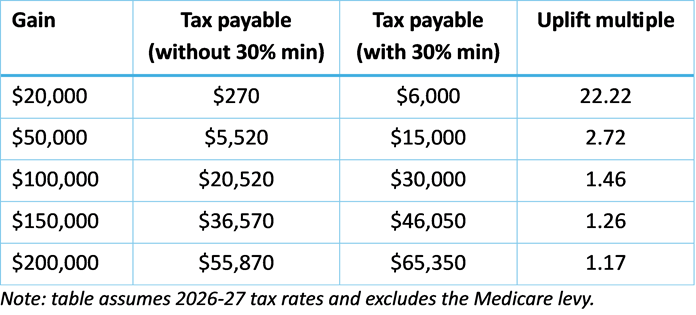
While investors would often have income from other sources, these numbers illustrate how a 30% minimum disproportionately affects low-income gains, weakening a progressive tax system. And making it more difficult to accumulate wealth prior to retirement.

The 30% minimum also amplifies the ‘bunching effect’ of the capital gain, an effect caused by gains accumulated over possibly many years being treated as a lump sum in the year of realisation. This potentially pushes investors into higher tax brackets than would otherwise be the case had the gains been smoothed over multiple years. The 30% floor then accelerates the push through the progressive tax schedule.

With the previous 50% discount acting to some extent as a shock absorber for the lumpiness of the gain, removing it and applying a 30% tax rate minimum is a double whammy on the taxation of gains.

3. The treatment of inflation is asymmetric.

Net rental losses are quarantined and frozen in nominal terms, such that the real value of future tax relief is steadily eroded by inflation over time. Meanwhile, the cost base of the asset is indexed for inflation.

The new rules are therefore asymmetrical in the sense that the government ignores inflation on what it is liable for. This creates a growing disadvantage with time for investors holding loss making properties.

A fairer way would be to capitalise the losses as they occur and index them in line with the asset’s cost base.

The asymmetry may be intentional by design to discourage investors from holding negatively geared properties for long periods.

4. A less favourable capital gains tax regime is likely inflationary.

When the taxation of capital growth increases relative to income, then the flow of capital would be expected to shift more towards yield. Money moves out of high-growth property development, as well as venture capital, and startups into commercial and regional type property, and high-dividend yield stocks.

And when capital investment stalls, productivity growth slows which impacts the supply side of the economy. That is, the economy cannot respond as well when demand in the economy inevitably rises due to population growth, government deficits, and wages growth. And excess demand in the economy is inflationary.

This is possibly an unintended consequence of a deliberate policy aim to “rebalance a system which is more generous to assets than it is to labour”, according to Jim Chalmers.

Of course, improving the taxation of income relative to assets, if that is the aim, could also be achieved by taxing income less while maintaining the status quo on the taxation of capital. And which should be a productivity enhancing approach.

Indeed this is an option that is being put forward by the Coalition, with Angus Taylor saying that he will take to the next election policies of repealing Labor’s capital gains tax and negative gearing changes, while indexing income tax brackets to inflation to eliminate bracket creep.

Battle lines on major taxation policy have finally been drawn.


Tony Dillon is a freelance writer and former actuary. This article is general information and does not consider the circumstances of any investor.


  •   20 May 2026
  • 22
  •      
  •   
22 Comments
Tony Dillon
May 22, 2026

Totally agree Jon. Why discriminate against income derived from assets when roughly two-thirds of individuals who report capital gains are also wage and salary earners? And also let’s not forget, that money invested in capital is often earned income net of tax already paid. And my point in the article that capital investment is productive investment.

1
James#
May 22, 2026

Typical Labor, always strong proponents of DIVISION, whether it be race, generations or wealth.

Cunningly pitting one group against another is a deliberate tactic to make changes by stealth because the ensuing imbroglio and messy, often incoherent debate, sews doubt and confusion, providing the perfect cover to advance your socialist agenda.

Keating, at least had one thing right, that good policy is good politics!

This is not good policy!

4
John Wilson
May 21, 2026

I'm frustrated by the claims that young people are being prevented by boomers and property investors having an unfair advantage in buying houses. There is probably some effect, but there are other factors increasing the cost of a house:
(1) Houses are now much bigger than their parents' or grandparents' first house (average freestanding house 165m2 in 1972 but 240m2 in 2025). That's a 45% increase in area and probably cost! They are also much "flasher" - not built from fibro, insulation, solar panels, more power points, swimming pool etc. More cost increase!
(2) GST increased house costs by 10%. As well, state government stamp duty was only 1% of the average $19k house in 1970, but is now 4-5% of the average $1m in 2025. Introduction of compulsory super from the early 1990s to the current rate of 12% is probably adding 8% to a house cost through labour content. All up, these government imposed costs have added around 20% to house cost.
(3)Young people are bleating that they need multiple incomes to have enough funds to compete with investors. That's true, but I think there is a chicken and egg situation. Many young people are choosing to have both partners working - to give them an interest, feeling of contribution and success. With their extra family income, they are able to bid up the price of a house.
Intergenerational equity is important. What young people need to trim is their expectations of what their first house should be. They grizzle about repayment of HECS - but when I was at uni pre-Whitlam, it wasn't free or supported by a low-interest government loan. Marginal tax rates were much higher. Through the 1970s and 1980s, inflation rates, bank interest rates and unemployment were much higher. Shouldn't the old fogies who experienced these conditions be helped (LOL)?

9
John
May 21, 2026

Thanks John. I was looking at charts re the growth in housing prices post 2000 without having focussed on the effect of the GST, or other costs for that matter. All part of trying to assess the relevance of Keating and Ralphand whether it's relevant to the future. So back to the thinking board!

GeorgeB
May 22, 2026

Pointing out such "inconvenient" truths about baby boomers' past tribulations (in true Basil Fawlty tradition you didn't mention the conscripts sent to fight a useless Vietnam war) definitely flies in the face of the government's narrative about "generational fairness" and should be suppressed with vigor???

2
Reader
May 24, 2026

On point (1), I agree -- houses are now much bigger and flasher than they used to be, and way more than I need. But as a prospective first home-buyer, show me where I can buy a cheap, fibro, 2 bed/ 1 bath/ no garage/small yard house now? You can only buy what exists in the market, and all I see are luxury $1.5M+ apartments, concrete dogboxes for investors to rent out, or oversized, expensive suburban houses. An exaggeration, but I think the economics of land value etc. (and possibly also catering for those who can pay) mean these are the things that get built.

Also, re. 'young' people needing to trim their expectations of what a first house should be - consider that by the time some current first homebuyers can afford to buy (especially if single), they are no longer that young. What you'll settle for at 25 with years of so-called 'climbing the housing ladder' ahead of you I think is different from what you'd be happy to buy at 40+, having saved hard for decades years and potentially not expecting to climb much further.

Francis H
May 20, 2026

Excellent Article which highlights how Labor is looking into every hollow log. The hand of Treasury is all over this. I wonder if they informed the Treasurer of the effects of his policy on the workers and battlers. Mr Chalmers needs to look more closely into the history of his mentor Paul Keating who ignored Treasury to establish our Superannuation system. They are still at it, banging on every year about tax foregone thanks to superannuation concessions . John Howard and Peter Costello had the good sense to ignore them as well.

3
Stephen
May 21, 2026

Indexation of tax brackets sounds good at first pass. The problem is that it is a pro-cyclical measure. That means it exacerbates conditions. For example if inflation is high, indexation raises the tax thresholds. This puts more money in people’s pockets, increasing demand and inflationary pressures.

The choice is then either government sharply cuts back its expenditure to reduce demand, or if it does not, the RBA has to raise interest rates higher.

What’s more likely? Governments won’t cut expenditure because of our short election cycle.

So if inflation is high indexation of tax thresholds will cause higher demand leading to higher inflation and the RBA will be forced to raise interest rates higher than if indexation had not been in place.

Be careful what you wish for.

2
Robert Backer
May 21, 2026

I am being careful when I wish for a government that watches its expenditure more closely. Chalmers comment that they will hand back brackets creep with later tax cuts is entirely self serving; just like claiming the stage tax cuts are his work. If handing back brackets creep is good policy, then get on and do it in the most effective manner (indexation)! The problem with recent governments of each flavour is that they have become addicted to spending for political purposes. Indexation of the tax thresholds would force some emphasis back on spending discipline.

2
Tony Dillon
May 22, 2026

Stephen, indexing tax thresholds for inflation would require governments to be disciplined in their spending. And less government spending means less crowding out of the private sector, which in turn raises the economy’s speed limit such that it can tolerate increased demand without that necessarily being inflationary. That is, the economy can absorb increased demand from consumers who get to take home more of their pay. Labor is against this approach because of its desire for bigger government.

2
Stephen
May 22, 2026

"Labor is against this approach because of its desire for bigger government"

Tony, here's something to consider. Governments of both sides have shown they are not capable of significant expenditure restraint. The LNP did nothing to restrain the growth of the NDIS when they were in power for 9 years. During COVID the LNP caused a massive increase in debt by showering profitable companies with billions of dollars no questions asked. At the last election the LNP proposed government fund nuclear power. Both the LNP and Labor want substantial increases in military expenditure of approximately 1% of GDP. The LNP is happy to have bigger government too as long as it accords with their preferences, they think it will win them votes and the money goes to their political supporters.

Governments won't restrain spending significantly and legislating full indexation of tax brackets will lead to increased deficits, debt, inflation and interest rates.

The only real control over government deficits and debt is the bond market.

Jim Bonham
May 21, 2026

Tony, thanks for this article.

As I understand it, you have interpreted the 30% minimum tax on the real capital gain to mean that the 0% marginal rate band and the 15% marginal rate band should both be replaced with a marginal rate of 30%. Are you sure of this?

My interpretation of the rather sparse cameo involving Jack on page 8 of the Budget explainer "Negative Gearing and Capital Gains Tax Reform" is that a 30% rate is applied to the entire real capital gain, and the result added to the conventional tax calculation (ignoring LITO, SAPTO and the Medicare levy) for any other taxable income. The sum of the two is then compared with the conventional calculation based on taxable income equal to the real capital gain plus other taxable income. The larger tax calculated prevails.

Thus, for the case of $200,000 real gain and no other income, the 30% minimum tax rate would give $60,000 tax, rather than $65,350 as per your table.

Two other points are worth noting: with the interpretation I suggest, the 30% minimum gives a lower result than the conventional calculation if the real gain exceeds about $225,000 and so the latter prevails for all higher gains (i.e. the 30% minimum tax rate is simply not used).With your interpretation the 30% min tax always gives the higher tax rate.

In thinking through this, I have realised that I have misunderstood the role of LITO, SAPTO and the Medicare levy (they have none in this comparison), so I might have to modify the post I made on Noel Whittaker's article. But I'd like to see your response first.

Tony Dillon
May 22, 2026

Jim, thanks. It’s worth probing because I agree, detail on the 30% minimum is lacking.

My interpretation is the gain is layered on top of other income as it always has, and taxed progressively. Any portion of the gain that would otherwise face rates below 30% is effectively topped up to 30%. Example, say there is a gain of $40k on top of $15k salary.

The 30% floor ‘effectively’ overrides the two lower marginal rates:
1. The $3,200 that expected a 0% rate is adjusted up to 30% ($3,200 = $18,200 - $15,000)
2. The $26,800 that expected a 14% rate is adjusted up to 30% ($26,800 = $ 45,000 - $18,200)
3. The $10,000 that naturally hit the 30% rate stays at 30% ($10,000 = $55,000 - $10,000)
Because every single dollar of the $40,000 gain is forced to a minimum of 30%, you pay a flat $12,000 in Capital Gains Tax (30% x $40,000). The actual $15,000 ordinary income remains untouched and completely tax-free at the bottom.

Similarly, the $200k standalone gain: 30% x $18,200 + 30% x ($45,000 - $18,200) + 30% x ($135,000 - $45,000) + 37% x ($190,000 - $135,000) + 45% x ($200,000 - $190,000) = $65,350.

Noting the Budget Explainer does say that the 30% minimum “will not affect people whose capital gains are already taxed at rates of at least 30 per cent”.

Cheers

1
Jim Bonham
May 22, 2026

Thanks for responding Tony.

If you put your first example around the other way ($15k gain and $40k salary), how much of the gain would be "expecting" a 0% tax rate?

My interest in the comment I posted on Noel Whittaker's article was the effect of introducing the minimum 30% rate on real gains, i.e. the difference between the results of the new calculation and the old.

By my interpretation, this peters out to zero if the gain exceeds about $225k. By yours, it persists at just under $10k regardless of how high the gain is.

Either way, the difference is immaterial for the claimed targets: real estate vendors.

I think we'll have to agree to disagree for now. Maybe someone else can provide some clarity. Thanks for your comments.

Tony Dillon
May 22, 2026

Jim, putting the example around the other way, none of the gain would be expected at 0%. The tax on the first $5k of the $15k would be upgraded from 14% to 30% = $800. The other $10k is already in the 30% tax bracket, so no further uplift. Result: an extra $800 tax payable with the 30% minimum than otherwise would be the case.

I agree that the maximum hit converges to just under $10k with increasing gains. Being: (30% - 0%) x $18,200 + (30% - 14%) x ($45,000 - $18,200) = $9,748. Which reflects the effective bumping up of the two lower marginal rates to 30%. So $9,748 will be the maximum impact of applying the 30% minimum, no matter what the gain.

But I don’t see convergence to a maximum impact of $9.7k being against my interpretation. Only that the reform effectively removes the benefit of the lower marginal brackets for capital gains, while leaving higher rates unchanged, remembering the Budget Explainer does say that the 30% minimum “will not affect people whose capital gains are already taxed at rates of at least 30 per cent”. And that appears consistent with the treatment of Jack in the budget example.

The government’s concern was Investors timing gains into years with low taxable income to exploit lower marginal rates. The 30% minimum removes the ability to do that. And I doubt the intention of the changes would be for the effect of the minimum to peter out at large gains, when small gains have been hit. It stays at the maximum $9.7k hit for large gains. Cheers

Tony Dillon
May 22, 2026

Sorry, that last point. Just to clarify. A hit of $9.7k occurs for large gains if the gain is the only income. In general, if income from non-gains exceeds $45k, then there is no hit, because the whole gain sits in 30% marginal tax rate territory or greater, so no need to apply a minimum 30%. That’s what the “will not affect people whose capital gains are already taxed at rates of at least 30 per cent” statement means.

Tony Dillon
May 23, 2026

I’ll try and provide some clarity Jim.

A taxpayer has a real CG of $250k. So under your interpretation of the 30% min tax rate, the gain will be taxed according to marginal rates, because it will give a greater tax result than 30% of $250k. And that would be the case whether there is additional non-CG income or not.

But let’s say there is other income of $200k in the year the gain is realised. All of the gain would therefore be taxed at 45%. If however, the gain was realised in a nil-other income year, tax on the gain falls by about $34k because the first $190k of the gain is subject to marginal rates less than 45%. So the investor has succeeded in reducing tax on his gain by selectively realising it in a year with access to lower marginal rates. The new 30% minimum tax rate has had no effect here under your interpretation (you rightly pointed out it would have no effect on gains greater than $225k, which is the point at which the average tax rate becomes 30%).

So the incentive to defer realisation into low-income years therefore remains unchanged under your interpretation. It has not reduced the incentive to defer gains into low-income years for sufficiently large gains. Yet the Budget Tax Explainer says: “The introduction of the minimum tax reduces the benefit of taxpayers deferring capital gains realisation to years where their marginal tax rates are low”.

By contrast, if by my interpretation the 30% minimum operates by lifting lower marginal rates on gains to 30%, tax on the nil-income year realised gain of $250k rises by the max $9.7k, reducing (though not eliminating) the timing advantage. This appears more consistent with the stated objective of imposing a minimum 30% tax rate on gains.

Hopefully this helps. It would be strange if the tax changes stopped being effective when timing benefits become large, if the intent was to discourage timing. Anyway, it would have been far better if the Explainer gave some more decent examples. Cheers

Jim Bonham
May 23, 2026

Tony, my interpretation was influenced by two sentences in the explainer: “A minimum tax rate of 30 per cent will apply to real capital gains…” and “ This will not affect people whose capital gains are already taxed at rates of at least 30 per cent”.

In particular, I read the second sentence as referring to the rate applying to the gain as a whole.

Maybe I’m wrong, maybe we both are. Eventually this should become clear.

Regardless of the detailed calculation, the stated justification “It ensures their gains are subject to a tax rate closer to the rate they faced during their working life” fails to recognise that the asset may have been bought long after retirement, or that it might have been bought and sold by a young person, with relatively low taxable income. I gave some examples in my comment on Noel Whittaker’s article.

Once again, thanks for the article and stimulating discussion.

Tony Dillon
May 24, 2026

Jim, for what it's worth. I thought "a minimum tax rate" and "rates of at least", meant multiple rates are at play which must mean marginal rates. Note "rates" plural. And "minimum" refers to a floor and invites the possibility of higher rates. Also, you "apply" marginal tax rates but not average tax rates. An average rate is an outcome not an input.

But who knows. The Explainer could be seen as ambiguous. And even though I think the intention is a marginal rate approach, at least logically anyway, I agree the precise method remains to be seen. Appreciate your input. Cheers

Jim Bonham
May 24, 2026

Tony,
The subtly different language on page 156 of Budget Paper No 1 (“The capital gains of people already subject to at least the 30% marginal rate on their non-capital gains income will not be affected by the minimum tax”, compared to "This will not affect people whose capital gains are already taxed at 30%" in the explainer) suggests to me that you are right.

I guess I’ll have to find my white flag.

Fortunately, none of this affects my qualitative conclusions.

Incidentally, this section of Budget Paper 1 says a lot about the mindset behind this tax. For example, it claims that by exempting pensioners and those on income support from the minimum tax, they have protected everyone with low income and low wealth.

Cheers
Jim

Francis H
May 25, 2026

I think the Government's projections of the revenue raised from the CGT and negative gearing changes is seriously out of step with likely investor behavior. Investors will flee existing properties so there will be limited turnover and less gains which equates to less tax. With indexation, both new and existing investors will wait until they have reached a 30 % tax rate on new gains before selling. Again lower turnover and less revenue. This means less supply and higher rents. And also higher inflation and higher interest rates. There will be a huge incentive to renovate the family home. Developers and builders of new properties will struggle to get subcontractors and workers. It will make much more sense for tradespeople to do renovations. Far fewer risks and far more reward.


Leave a Comment:

RELATED ARTICLES

Noel Whittaker’s take on the budget

3 ways to defuse intergenerational anger

Selling your holiday home? You may be able to pay less tax

banner

Most viewed in recent weeks

2 billion reasons to fix retirement income

A proposal to address Australia's 'stranded balances' in retirement by requiring super funds to transition members to pension phase at 65, boosting retirement income and reframing super as a source of income.

The ultimate superannuation EOFY checklist 2026

Here is a checklist of 28 important issues you should address before June 30 to ensure your SMSF or other super fund is in order and that you are making the most of the strategies available.

Do super funds need a massive wake up call?

UK retirement expert, Guy Opperman, believes super funds are failing at supporting members in deaccumulation. Here is what Australia should do about it. 

Two months into retirement

A retirement researcher's take on retirement and her focus on each of her six resource buckets to stay engaged during the transition and beyond.

Welcome to Firstlinks Edition 662 with weekend update

The debate over the budget is increasingly shaped by frustration and perceptions of unfairness, rather than clear-eyed assessment of policy outcomes.

How inflation is quietly moving the goalposts on retirement

Inflation doesn’t just raise today’s bills - it quietly increases the amount needed to retire, while simultaneously making it harder to save. Three steps to take before June 30th to improve retirement outcomes.

Latest Updates

Back to the future - Why indexing CGT is a good idea

A return to indexation of capital gains would be a fairer way to compensate households for the effects of inflation than the current discount. Importantly, it opens the door to future, broader reforms to stop the taxation of inflation.

Australia has no death duties. Technically.

Australia may not levy formal death duties, but a growing web of tax measures is quietly shaping what wealth passes between generations. Now, the 2026 budget adds another layer.

Strategy

The folly of the Iran war

From oil shocks to fractured alliances, the Iran war carries the hallmarks of a historic policy misstep - one that could tip an already fragile global economy into crisis.

Taxation

Noel Whittaker’s take on the budget

Marketed as a fix for inequality and housing affordability, the latest budget instead delivers a tangle of tax changes that leave everyday Australians worse off.

Investment strategies

The red metal's long game

Copper has had a rough few weeks but investors should not ignore the potential for future price increases as supply increasingly falls behind demand.

Taxation

The lesser-known effects of changed property taxes

The budget’s property tax reforms are being framed as fairness measures, but they risk splitting the housing market, penalising lower‑income investors and introducing distortions that may prove costly.

Latest from Morningstar

Why stocks sometimes fall for no obvious reason

The vast and opaque world of private assets is a powerful gravitational force - and when trouble hits, it's the more liquid public equities that often the feel it first.

Sponsors

Alliances

© 2026 Morningstar, Inc. All rights reserved.

Disclaimer
The data, research and opinions provided here are for information purposes; are not an offer to buy or sell a security; and are not warranted to be correct, complete or accurate. Morningstar, its affiliates, and third-party content providers are not responsible for any investment decisions, damages or losses resulting from, or related to, the data and analyses or their use. To the extent any content is general advice, it has been prepared for clients of Morningstar Australasia Pty Ltd (ABN: 95 090 665 544, AFSL: 240892), without reference to your financial objectives, situation or needs. For more information refer to our Financial Services Guide. You should consider the advice in light of these matters and if applicable, the relevant Product Disclosure Statement before making any decision to invest. Past performance does not necessarily indicate a financial product’s future performance. To obtain advice tailored to your situation, contact a professional financial adviser. Articles are current as at date of publication.
This website contains information and opinions provided by third parties. Inclusion of this information does not necessarily represent Morningstar’s positions, strategies or opinions and should not be considered an endorsement by Morningstar.